
Chemical Toll Blending Minimum Order Quantity: A Planning Guide
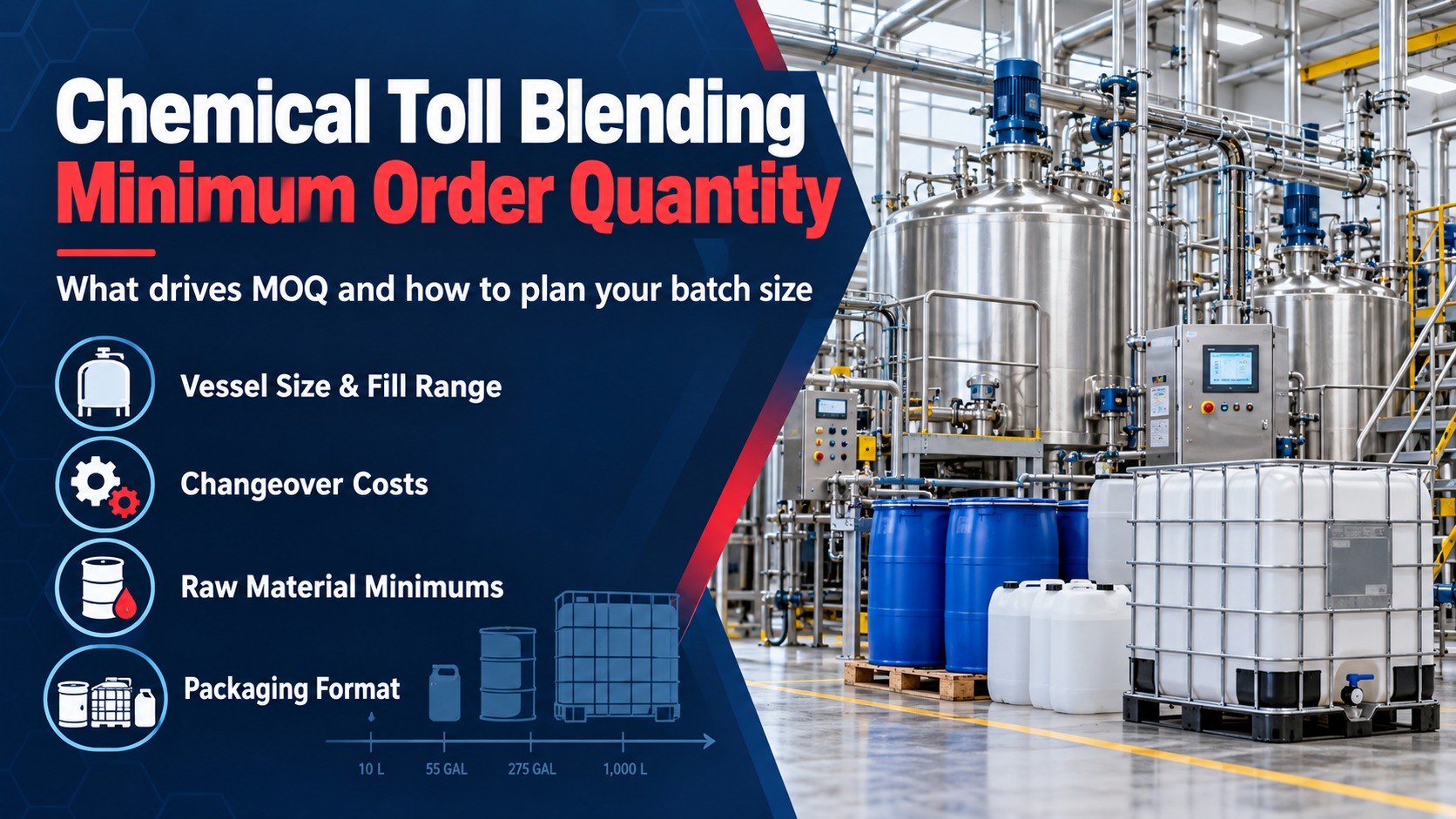
If you are comparing contract manufacturers, the chemical toll blending minimum order quantity a partner requires is one of the first numbers that shapes your budget, your inventory plan, and your launch timeline. Procurement teams and product managers are usually asking two questions at once: how much cash do I need to commit up front, and how much room do I have to scale up or down later? The honest answer is that minimums come from physical equipment limits and raw material buying rules far more than from any arbitrary policy meant to protect margin.
Knowing where those limits come from gives you leverage. You can design formulations around standard ingredients, choose packaging that fits the batch, and sequence pilot and commercial runs so you never pay to produce more than you can sell. At Industrial Technology Corporation, we walk customers through this math before the first batch is scheduled, and this guide lays out the same logic in plain terms.
What Determines a Chemical Toll Blending Minimum Order Quantity
A minimum order quantity is the smallest volume of a custom formulation a blender can produce in one run while keeping the batch uniform and covering the real cost of running the equipment. Four forces set that floor: vessel geometry, changeover labor, raw material purchasing, and packaging format. Each one is physical or logistical, which means each one can be planned around once you understand it.
Why Every Chemical Toll Blending Minimum Order Quantity Starts With the Vessel
Mixing vessels are engineered to work within a fill range. The liquid level has to cover the impeller so the batch circulates, and in temperature controlled formulations it has to cover enough of the jacketed wall for heating or cooling to work. In dry blending, the powder bed has to reach the agitator so the material is actually lifted and folded. Run below that range and the blender is no longer making a batch at all, it is moving material around without mixing it evenly.
Research on ribbon blade mixers supports this. In one peer-reviewed study of granular mixing in a ribbon blade blender, final mixing homogeneity increased as fill height increased, most clearly across the 30 to 70 percent volume range that was tested. Equipment makers also commonly advise against operating a ribbon blender below roughly 30 to 40 percent of its rated volume, because the agitator cannot generate enough contact with the product.
Clean-Down Time and Changeover Costs
Between formulations, equipment has to be cleaned thoroughly so one customer’s chemistry never carries into the next. Flushing lines, cleaning vessels, and verifying the equipment is ready takes labor and takes the vessel out of production. That cost is fixed whether the run is small or large, so a very small batch carries a heavy changeover burden per gallon or pound. When a blender prices a short run, a meaningful share of the price is the cleaning, not the blending. Customers who run the same formulation repeatedly, or who group similar products together, spread that cost across more volume.
Raw Material Purchase Minimums
Suppliers sell ingredients in drums, totes, bags, and pallets. If your formula calls for a small amount of a specialty surfactant, solvent, or additive, the blender may still need to buy a full container to fulfill the run. That purchase minimum becomes a floor under the blender’s own minimum, and it can quietly raise the effective MOQ of every run that uses the ingredient.
How to Reduce the Raw Material Floor
- Choose standard, widely stocked ingredients wherever performance allows.
- Consolidate formulations so several products share the same specialty inputs.
- Share your annual forecast so the blender can buy ahead and spread the purchase across scheduled runs.
Summary of the Main MOQ Drivers
| Driver | What It Controls | How You Can Plan Around It |
|---|---|---|
| Vessel size and fill range | Smallest batch that mixes uniformly | Match batch volume to a vessel that fits it |
| Clean-down and changeover | Fixed labor cost per run | Group similar products and use repeat scheduling |
| Raw material pack sizes | Minimum ingredient purchase | Standardize inputs and share annual forecasts |
| Packaging format | Filling cycles and leftover product | Align batch size with whole container counts |
| Viscosity and chemistry | Pump, motor, and vessel compatibility | Confirm equipment fit early in development |
Liquid vs. Powder Batch Size Minimums
Liquid and dry blending are different operations, so their minimums are calculated differently. A blender with a fleet of mid-size tanks will set a different floor than one running large powder vessels, and neither will match a generic number you read in an industry overview. The only reliable way to learn a real minimum is to describe your product and let the blender match it to the right equipment.
Liquid Tank Constraints
Liquid production is organized around tank capacity, pump flow rates, and temperature control. The tank has to hold enough liquid to submerge the impeller and keep the batch stable, and viscosity changes everything. A thick industrial degreaser needs different pumps and mixing energy than a thin, water based wash concentrate, so a blender running both will not apply the same minimum to each. Customers developing car wash concentrates or industrial degreasers should raise viscosity and foaming behavior early, because both affect which tank and pump the batch needs. For a closer look at tank based production, see our liquid formulation capabilities.
Powder Blender Fill Levels
Dry blending relies on ribbon blenders or plow mixers, where the physical volume of the vessel sets a hard lower boundary. You need enough material to generate the shear and folding action that produces a homogeneous blend, and there is no workaround for a blender running at a small fraction of its rating. The practical result is that powder minimums are often tied to the usable working volume of the blender, which is lower than the total shell volume. Our ribbon blender powder production is organized around exactly this constraint.
Side by Side Comparison
| Factor | Liquid Blending | Powder Blending |
|---|---|---|
| Primary equipment | Tanks, pumps, flow meters | Ribbon blenders, plow mixers |
| What sets the minimum | Impeller coverage and temperature control | Powder bed reaching the agitator |
| Biggest wildcard | Viscosity and foaming | Particle size and bulk density |
| Typical packaging | Pails, drums, totes, bulk | Bags, drums, totes, bulk bags |
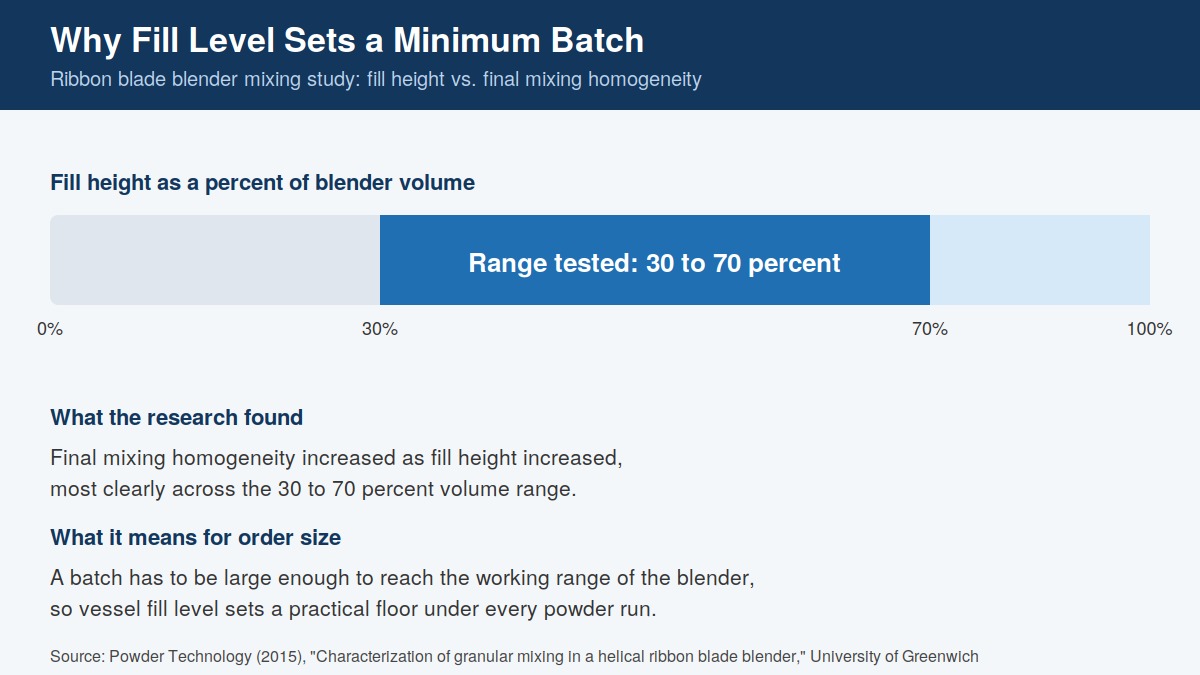
Source: Powder Technology (2015), University of Greenwich research repository.
Packaging Format and Effective Run Size
Packaging is one of the most overlooked drivers of the minimum you will actually be quoted. Smaller containers such as 5 gallon pails take more filling cycles, more labor, and more handling per unit of product than drums, totes, or bulk tankers. That operating cost shows up in the minimum run a blender will accept for a given container. If you are still deciding between formats, our packaging configurations from pails to bulk can be matched to your expected volume.
Heel and Yield Loss
Batch volume should also line up with the container count. Any product left behind in the vessel after filling, known as heel, is lost yield and adds to clean-down work before the next run. A batch sized to fill a whole number of drums or totes wastes less than one that leaves a partial container and a residue in the tank.
Regulated Products and Hazmat Handling
Formulations that ship as regulated materials need compliant containers, labels, and documentation, and that can influence which pack sizes make sense. Planning for hazmat ready packaging at the start avoids a late change to container size that would force a different batch volume.
Pilot, Small Batch, and Commercial Run Types
Most product launches move through three stages, and each stage has a different goal. Choosing a partner who can support all three prevents the handoff problems that appear when development happens in one facility and production in another.
| Run Type | Purpose | Planning Notes |
|---|---|---|
| Pilot batch | Validate chemistry, stability, and packaging compatibility | Smallest commitment; confirm the formula before any market commitment |
| Small batch run | Regional market tests and niche industrial applications | Limits inventory risk and protects cash flow |
| High volume run | National distribution and repeat supply | Per unit cost improves and scheduling becomes predictable |
Running a full commercial volume on an unproven formula is a cash flow risk most businesses cannot justify, which is why a pilot stage is worth building into the plan. Brands that sell under their own label often start with a pilot and then expand, and our team supports that path for private label product lines from the first sample through repeat production.
Federal Reporting Thresholds Are Not the Same as Order Minimums
Buyers sometimes confuse a blender’s commercial minimum with the annual quantity thresholds that trigger federal toxic chemical release reporting. They are separate. The reporting thresholds apply to a facility’s yearly totals, not to your order, but they influence how a blending partner schedules, tracks, and documents runs that involve listed chemicals. Under the national program, the standard annual threshold is 25,000 pounds for manufacturing or processing a listed chemical and 10,000 pounds for other use. Chemicals that persist and accumulate in the environment face far lower triggers, down to 100 pounds and 10 pounds.
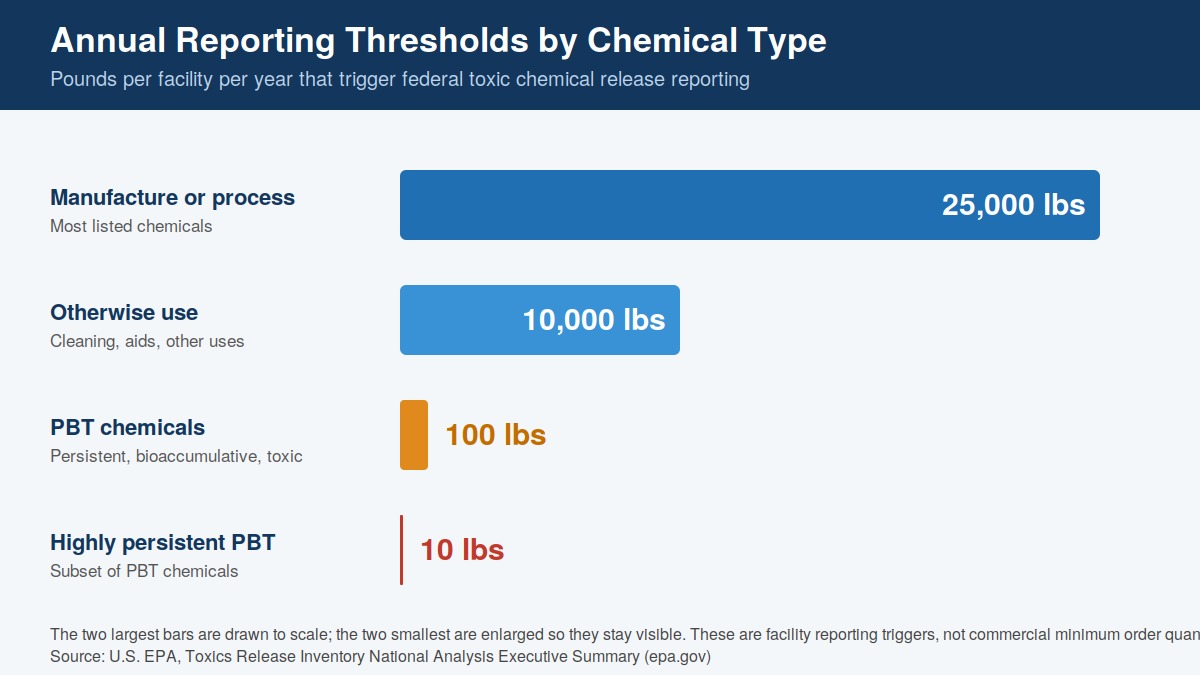
Source: U.S. EPA Toxics Release Inventory national analysis executive summary. For a deeper look at reporting scope and how the activity categories are defined, review this federal introduction for facilities.
If your formulation includes regulated solvents or other listed ingredients, raise them in your first conversation so reporting, documentation, and volume planning are handled together from day one.
How to Negotiate and Scale Order Quantities
Minimums are rarely fixed in stone. The variables behind them, including equipment scheduling, raw material purchasing, and clean-down time, respond to good planning. Buyers who arrive with a clear picture of annual volume, formulation complexity, and packaging requirements regularly get better terms than those who open with a single run and no forward view. Our full scope contract blending programs are built to flex around that kind of forward planning.
Commit to Annual Volume With Scheduled Releases
An annual volume agreement with scheduled release dates gives the blender predictable scheduling and lets them buy raw materials in larger, cheaper quantities. That predictability reduces the per run overhead they need to recover, which is often the lever that makes a lower minimum possible.
Standardize Ingredients and Share the Forecast
Formulas built around readily available inputs avoid the purchase minimums that inflate small runs. Sharing a realistic twelve month forecast, even a rough one, helps the blender plan purchasing and schedule equipment time around your demand curve.
Use One Partner From Development Through Commercial Production
Keeping pilot and commercial work with the same blender removes the technical transfer that often causes formulation drift. It also builds a shared record of what the formula needs at each scale.
Scaling From Pilot Batch to Full Production
Moving from a pilot to a commercial batch is where many quality problems begin. Viscosity behavior, mixing time, and ingredient feed rates all shift as batch size grows, and those shifts are not always linear or predictable from bench scale data. Each increase in scale should be checked against the pilot sample, with adjustments documented so the commercial batch matches what you approved.
What to Verify at Each Scale Increment
- Viscosity and appearance compared with the approved pilot sample
- Mixing time and agitation settings for the larger vessel
- Ingredient addition order and feed rates
- Packaging compatibility and fill accuracy at the new container size
- Stability results before the first full commercial release
Once a product is running at volume, outbound logistics matter as much as the blend itself. Our warehousing and outbound freight support lets finished product be stored and released against your demand instead of all at once. We serve customers across many sectors, and you can see the full range of industries we support when you are mapping your product to the right production approach.
Frequently Asked Questions
What is MOQ in chemical manufacturing?
MOQ stands for minimum order quantity. In contract chemical manufacturing it is the lowest volume a blender can produce in one run while covering operating costs and keeping the batch consistent. The floor is set by physical equipment limits such as vessel size and impeller geometry, and by operating costs such as clean-down labor and setup time. Batch consistency is the firm constraint, because a run that is too small for the vessel can produce material that does not meet specification.
What are typical minimums for chemical toll blenders?
Minimums vary with whether the product is a liquid or a dry powder, the blender’s equipment, the packaging format, and raw material sourcing. Some large blenders require truckload volumes before they schedule a run, while more flexible partners can accommodate smaller batches for development or niche applications. Because a real number depends on your formulation, the best way to learn it is to describe the product and request a custom quote.
How does scaling from pilot batch to full production work?
The process starts with a small pilot batch to validate chemistry, stability, and packaging. After the pilot meets specification, the formula moves to a larger vessel with mixing time, ingredient feed rates, and temperature adjusted for the new scale. Using the same blender for both stages reduces the risk of formulation drift during technical transfer.
Are there flexible toll manufacturing options for small batches?
Yes. Some toll blenders support small batch work for new product launches, regional tests, and niche applications where volume is naturally limited. Small runs help manage cash flow and inventory risk during validation, and packaging can scale from pails to bulk as demand grows.
How does capacity planning affect a chemical toll blending minimum order quantity?
Capacity planning schedules equipment, labor, and raw materials across a mix of large runs and small custom batches. A facility running near capacity may need larger minimums to justify a schedule change, while one with open time can be more flexible. Sharing an annual forecast helps the blender plan ahead and often supports smaller or more frequent runs.
Why do powder and liquid products have different minimums?
Liquid blending is limited by tank volume, impeller coverage, pumps, and temperature control, while powder blending is limited by the working volume of ribbon blenders or plow mixers. Viscosity matters on the liquid side, and particle size and bulk density matter on the powder side, so the same batch volume does not suit both.
Plan Your Next Blending Run
Understanding a blender’s minimums turns a procurement detail into a supply chain planning tool. The businesses that handle it well enter the conversation knowing their annual volume, formulation complexity, and packaging needs, which shortens onboarding and reduces cost surprises. Tell us about your product and we will recommend a batch size, packaging format, and scale up path that fits it. You can request a custom blending quote online or call (563) 322-4882 to talk through your formulation.