
Certificate of Analysis in Chemical Blending: What It Proves
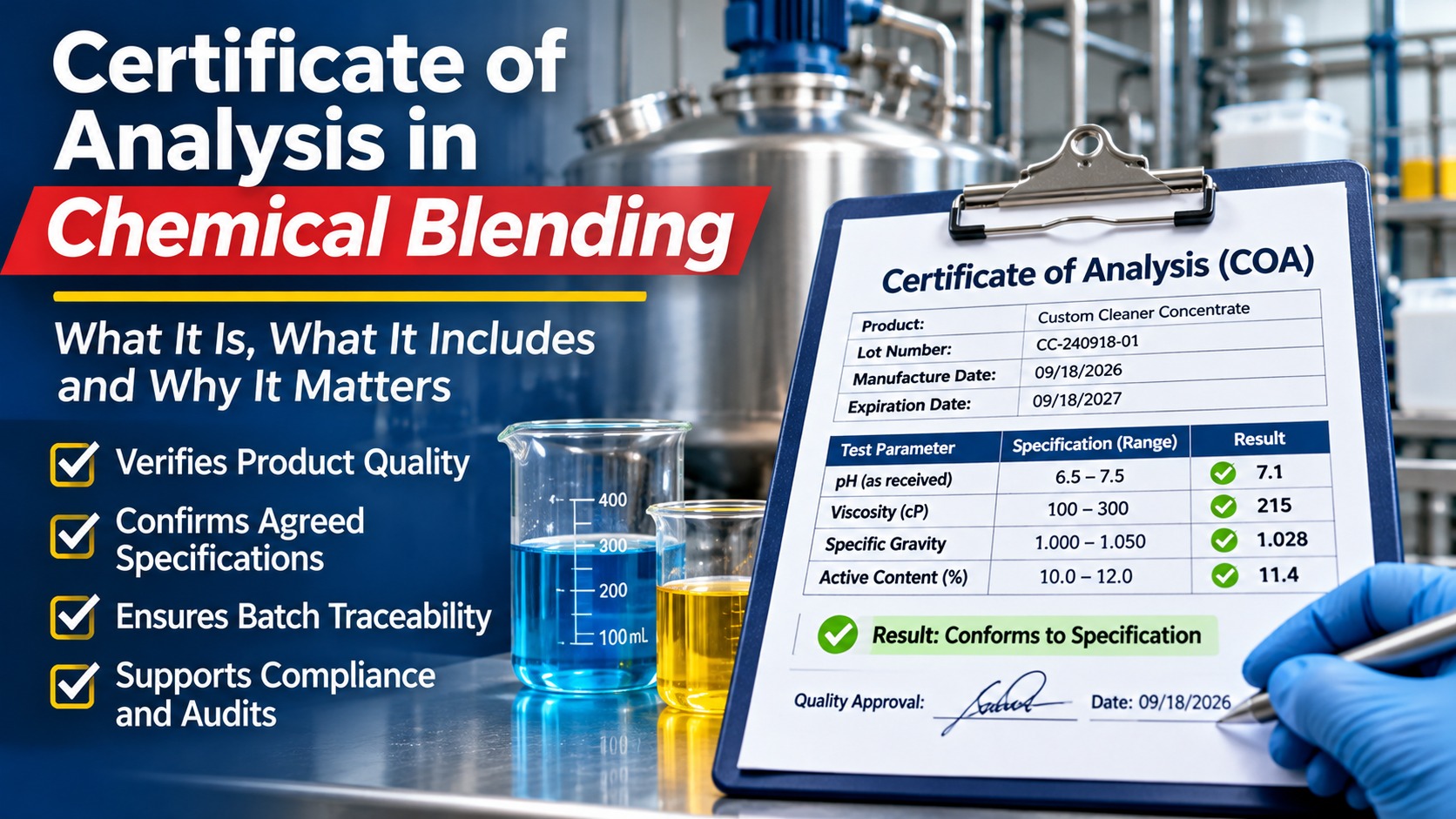
A certificate of analysis in chemical blending is a formal, batch-specific document that verifies a custom chemical mixture meets its agreed specifications based on quality control testing. It is not a product brochure or a generic technical summary. It is measured evidence, tied to one lot number, that the formulation in the container matches what was ordered.
For procurement managers and quality specialists, an off-spec batch has immediate and concrete consequences. A car wash concentrate blended at the wrong pH can strip coatings instead of cleaning them. An industrial degreaser with an active ingredient outside tolerance fails on the line and triggers a root-cause investigation that costs hours and credibility. A commercial cleaner that performs differently from one batch to the next wears down customer trust in a way no discount repairs. The certificate of analysis, usually shortened to COA, is the record that keeps those problems from reaching your floor.
At Industrial Technology Corporation, a COA accompanies every batch of custom liquid and powder formulations we blend, because documentation is part of the manufacturing job and not an administrative afterthought.
How a Certificate of Analysis in Chemical Blending Works
A COA is not interchangeable with a product specification sheet. A specification sheet describes what a formulation is designed to do and the parameters it should meet. A batch COA reports what one specific lot measured during testing, which shows the gap, if any, between a design target and a confirmed result. For teams managing supply chain risk, that difference matters, because a target is an intention and a measurement is a fact.
Chemical mixtures are hard to verify by inspection. Two blends can look identical in the drum and still differ in concentration, pH, or viscosity enough to change how they perform. Batch-level documentation gives your quality team numbers to work from instead of assumptions, and it gives you something concrete to compare against the ranges you agreed on before production began.
What Happens Before a Certificate of Analysis in Chemical Blending Is Issued
The COA is the final step in a quality control sequence that begins before blending starts. Raw materials are verified on receipt, testing equipment is calibrated against certified reference standards, the batch is blended, and samples are tested against the agreed specification ranges. Only then does a qualified person review the results and sign the document. Because the instruments were checked against verified standards first, the measurements on the COA rest on a documented baseline, which is what makes the record defensible when an auditor or a downstream customer asks for proof.
Agreed Specifications Come First
Before production, we work with each customer to define acceptable ranges for the parameters that matter most to their application. Those ranges become the acceptance criteria in the results table of the COA. Testing methods are chosen to suit the formulation, since a thin water-based wash concentrate and a dry powder blend do not need the same protocol.
Key Components of a Chemical Blending COA
The parameters tested vary by product. pH and viscosity matter most for liquid cleaners, while moisture content and bulk density are important for powders. The structure of the document stays consistent, which lets a receiving team verify shipments quickly regardless of which product is on the dock.
| Section | What It Contains | Why It Matters |
|---|---|---|
| Header and manufacturer information | Blending facility, contact details, and the customer purchase order reference | Ties the document to the right order and supplier |
| Product and lot identification | Product name, product code, and unique lot number | Must match the container label for traceability |
| Specifications and test results | Parameters tested, minimum and maximum limits, measured results, and test methods | The core evidence that the batch is on spec |
| Dates and shelf life | Manufacture date, test date, and expiration or retest date | Confirms stability over the intended service life |
| Quality approval | Name, title, signature, and date of the reviewer | Creates accountability for the release decision |
Why the Signature Matters
A COA without a named, qualified signatory is a data sheet with a logo on it. The signature shows that a qualified person reviewed the results, compared them with the agreed ranges, and judged the batch fit for release. That accountability is what makes the document useful during an audit or a field failure investigation. The lot number deserves the same attention: it should match the label on every container, whether a 5 gallon pail or a bulk tanker, and our packaging and labeling options are set up so the two always agree.
COA vs. SDS vs. CoC: Understanding Batch Documentation
Procurement teams new to toll blending often ask why a COA is needed when they already have the safety data sheet. The two documents answer different questions and cannot stand in for each other.
Safety Data Sheet (SDS)
An SDS is a standardized hazard communication document. Under federal rules it follows a 16-section format covering identification, hazards, composition, first aid, handling, exposure controls, and related topics. It describes the product category and does not change from lot to lot. The SDS tells your receiving team how to handle the material safely. It does not tell your quality team whether a particular batch is correct.
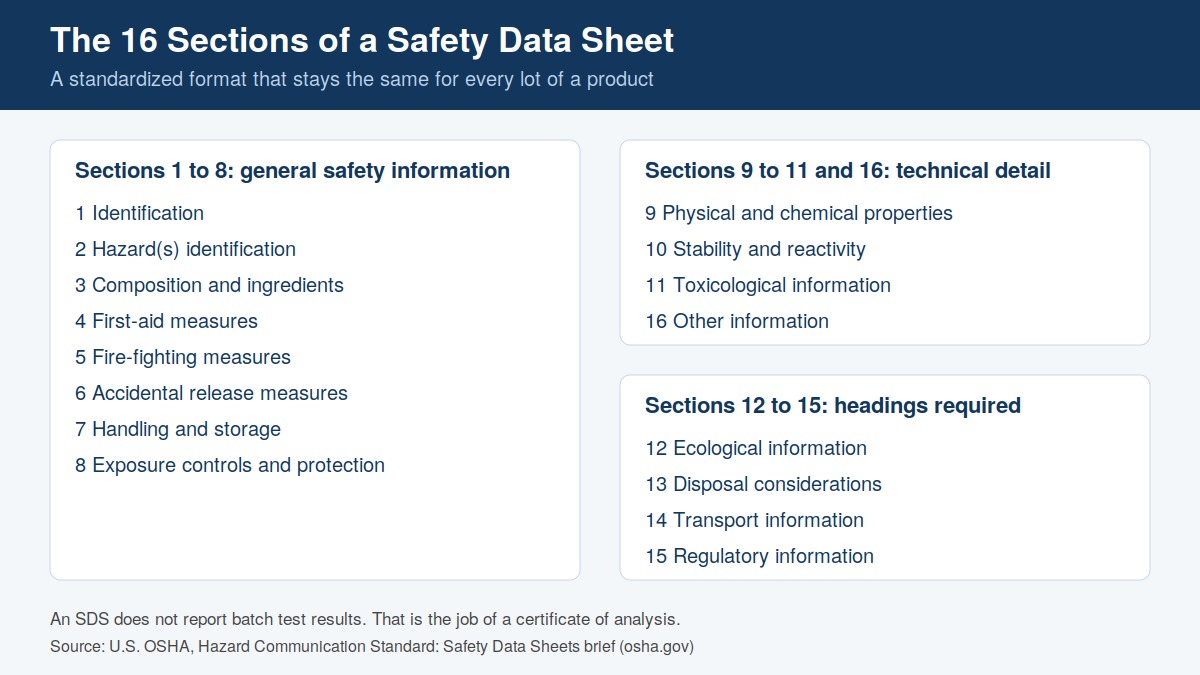
Source: U.S. OSHA Hazard Communication Standard: Safety Data Sheets brief.
Certificate of Conformance (CoC)
A certificate of conformance is a signed statement that a shipment meets contract terms. It usually contains no test data, no measured values, and no analytical verification. That makes it a contractual declaration rather than a quality record. A quality specialist cannot use it to confirm active ingredient concentration, check a dilution ratio, or investigate a failure in the field, because there are no numbers to work with.
An Easy Way to Remember the Difference
Think of an SDS as the owner’s manual for a vehicle model, written for every unit of that model and explaining how to operate it safely. A COA is the inspection report on the specific vehicle you just bought, with the exact readings and tolerances for that unit. The manual is generic to the design, and the inspection report is specific to the one in your driveway.
| Document | Main Purpose | Batch-Specific | Contains Measured Results |
|---|---|---|---|
| Certificate of analysis (COA) | Verify quality and specification compliance for one lot | Yes | Yes |
| Safety data sheet (SDS) | Communicate hazards and safe handling | No | No |
| Certificate of conformance (CoC) | State that contract terms were met | Sometimes | No |
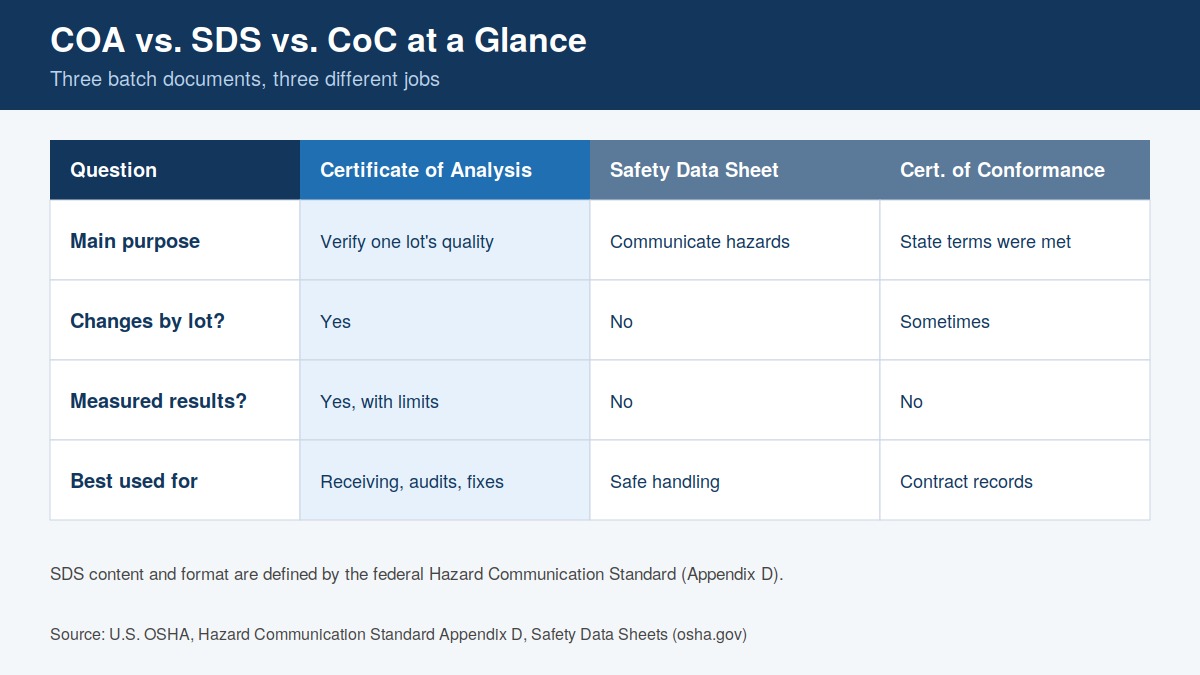
Source: U.S. OSHA Hazard Communication Standard, Appendix D safety data sheet requirements.
Why a COA Is Critical for Quality Assurance and Compliance
Compliance depends on proof. Facilities that operate under a recognized quality management framework, such as ISO 9001 quality management requirements, document how products are verified, and a COA is one of the records that shows the system working. It gives auditors a paper trail, supports compliance checks on regulated properties such as volatile organic compound content when that parameter is part of the agreed specification, and links a specific production run to the standards it was built to meet.
When a regulatory or customer inquiry arrives, and in industrial chemical manufacturing it eventually does, the COA answers it with measured data rather than memory. It is much easier to respond to a question about a lot shipped months ago when the lot number, test results, dates, and approver are already on a single signed record.
Compliance Support for Specific Product Types
If you formulate products for the transportation sector, such as wash concentrates, wheel brighteners, or surface preparation chemistries, your batch records need to hold up under both customer and regulatory scrutiny. Our automotive chemical blending capabilities pair precise production with complete batch transparency, and our car wash concentrate production follows the same documentation standard. Industrial maintenance products are handled the same way through our degreaser manufacturing.
Operational Benefits of Working With a Blender That Provides a COA
- Lower supply chain risk: Off-spec material is caught before it enters your production line, which prevents downtime and avoidable recalls.
- Faster receiving inspections: Your team matches the lot number on the container to the COA and verifies results against the agreed ranges, which removes guesswork at the dock.
- Evidence-based troubleshooting: If a product behaves unexpectedly in the field, such as a cleaner struggling in hard water, the measured data helps you investigate stability or adjust dilution without starting over.
- Audit readiness: Signed, dated, lot-specific records make quality reviews faster and less stressful.
- Consistency across batches: Comparing COAs from repeat orders shows whether a product is holding steady over time.
These benefits apply whether the product is a liquid or a dry blend. Our liquid formulation production and dry powder blending each use test parameters suited to the physical form of the product.
What to Look for in a Blending Partner
A blender’s willingness to issue a detailed, signed, batch-specific COA on every run tells you a lot about how it operates when no one is watching. If your current supplier struggles to provide consistent documentation or to hit your specifications, it is reasonable to compare options. Brands selling under their own name have even more at stake, since their reputation rides on every shipment, which is why documentation is built into our private label production. You can also see the range of sectors we support under industries served, and how finished product moves from release to delivery through warehousing and shipping.
How to Read and Use a COA When It Arrives
A COA only protects you if someone checks it. A simple receiving routine takes a few minutes and catches most documentation problems before material is released to production.
- Confirm the lot number on the COA matches the label on every container in the shipment.
- Check that the product name and code match your purchase order.
- Compare each measured result with the minimum and maximum limits listed for that parameter.
- Verify that the manufacture date, test date, and expiration or retest date make sense for the product.
- Confirm the document is signed and dated by the approving reviewer.
- File the COA with the receiving record so it can be found by lot number later.
If Something Does Not Match
If the lot number or any result does not line up, hold the material and contact your blending partner before it is used. A mismatch breaks the chain of traceability, and it is far easier to resolve at the dock than after the product has been dispensed or shipped to your own customers.
Frequently Asked Questions
What is the difference between a COA and a certificate of conformance?
A certificate of conformance is a signed statement that a shipment meets contract terms, and it typically contains no measured data. A certificate of analysis is a batch-specific quality document that lists the actual test results and specification ranges for one lot. If a batch fails in the field, a certificate of conformance gives you nothing to investigate, while a COA gives you the numbers.
Who issues a certificate of analysis in chemical blending?
The chemical manufacturer or toll blender that performed the blending and quality control testing issues the COA. It should be signed and dated by a qualified quality specialist or chemist who verified the results, not by a sales or logistics representative. The signature creates a clear line of accountability from the test data to the person who approved the release.
How long should a company keep certificates of analysis?
Retention periods depend on your quality system, customer contracts, and any rules that apply to your industry or product. Many companies keep COAs at least through the shelf life of the product, and some keep them longer to support audits and complaint investigations. Confirm the requirement with your compliance team and keep each COA filed by lot number so it can be retrieved quickly.
Can a COA be used to verify VOC content for commercial cleaners?
Yes, when volatile organic compound content or a related property such as specific gravity is included in the agreed test parameters. The COA then shows the measured value for that batch, which gives you a record to support compliance reviews. Tell your blender early which regulated properties you need reported so they are added to the specification.
What should I do if the lot number on the container does not match the COA?
Do not use the material. A mismatch means you cannot confirm that the document describes what is in the container. Contact your blending partner right away to obtain the correct batch-specific COA before releasing the product to production.
Do all chemical blenders provide a COA with every batch?
Not necessarily. Some suppliers issue a certificate only on request, or provide a certificate of conformance without test data. Ask any prospective partner whether a signed, lot-specific COA with measured results is included with every run, and review a sample before you commit.
Get Batch Documentation Your Quality Team Can Rely On
A certificate of analysis is the most direct answer to a question every quality manager eventually asks: how do I know what is in this container? It turns a shipment into a verified, traceable, and auditable asset that supports production confidence, compliance, and troubleshooting. Every run we complete ships with a COA that reflects the agreed specifications, the measured results, and the signature of the professional who verified them. To discuss your formulation and the parameters you need documented, reach out to our team or call (563) 322-4882. Our contract blending programs are built to support your quality goals from initial scoping through full-scale production.