
Chemical Compatibility Testing Before Custom Blending
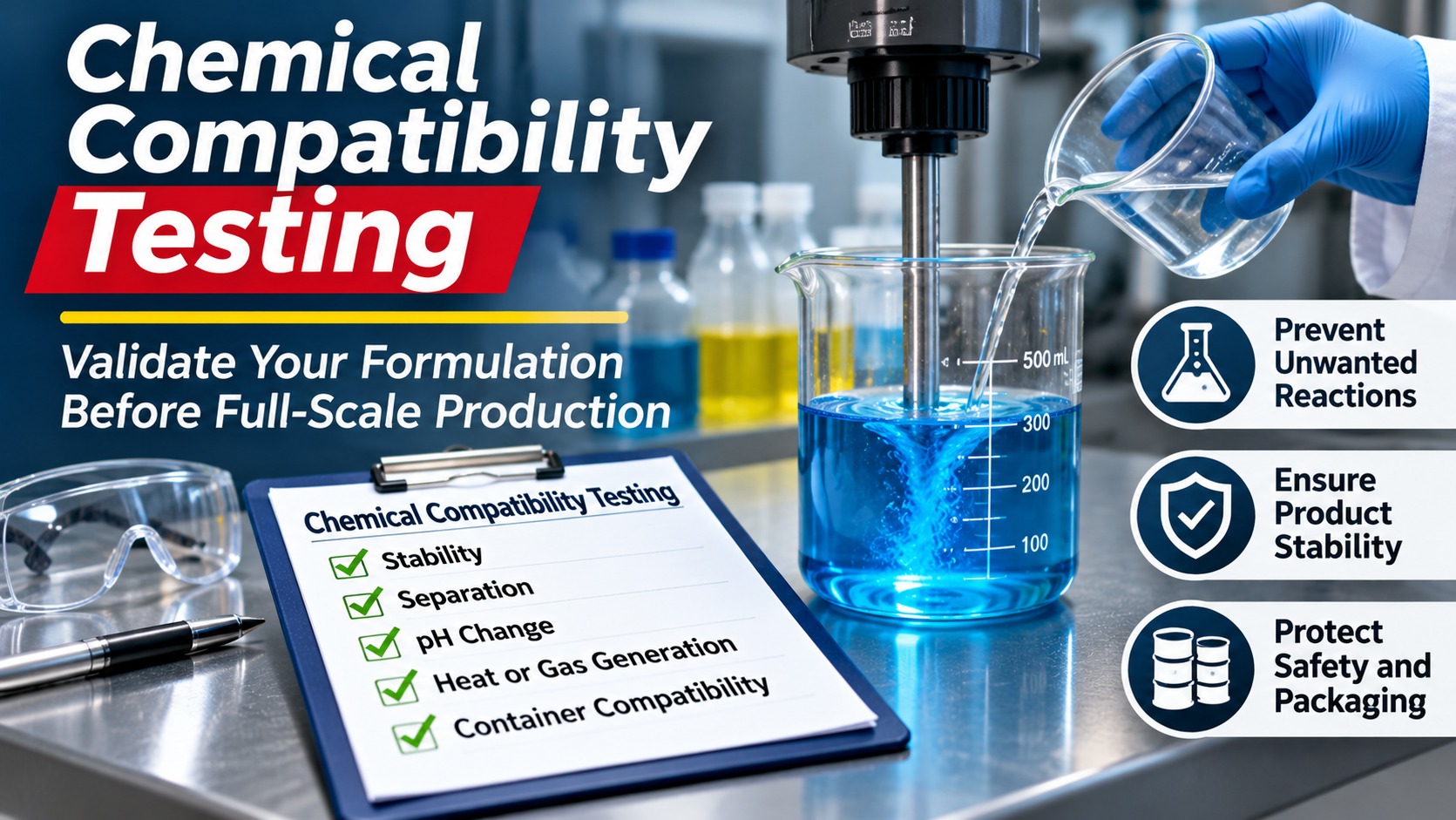
Chemical compatibility testing is the bench-scale evaluation of how raw materials, the finished formula, and its packaging behave together before a full commercial batch is ever blended. It screens for separation, unexpected heat or gas, pH drift, and container damage while a problem still costs a few beakers of material instead of a few thousand gallons. For any brand moving a liquid or powder formula into larger volumes, this step protects product quality, worker safety, and the schedule you promised your customers.
A formula that looks flawless in a 500 mL beaker can behave very differently in a large vessel, in a warehouse, or on a truck. Mixing energy, heat build-up, ingredient addition order, and storage conditions all change at scale. Knowing how your ingredients interact first lets a blending partner adjust the formula, choose the right containers, and set realistic production timelines. It also makes every later step, from custom blending capabilities to final packout, more predictable.
Why Chemical Compatibility Testing Comes Before Every Custom Blend
Skipping early screening does not remove risk. It simply moves the risk to the most expensive place to discover it. A separated emulsion, a gelled concentrate, or a drum that swells in storage each trace back to an interaction that a short bench evaluation could have caught. Pre-blend screening turns those unknowns into data you can act on.
What Happens at the Bench Before a Full Batch
Bench work starts with a formulation review. A technical team looks at every ingredient, its concentration, its role in the formula, and the order in which ingredients are added. Small test batches are then blended and observed under controlled conditions. Technicians watch for cloudiness, layering, precipitation, temperature change, gas evolution, and changes in color or odor, then record how the sample holds up over hours, days, and weeks.
The results show whether the formula can move forward as written, needs a minor adjustment, or requires a different ingredient altogether. That decision is far easier to make before raw materials are purchased and before packaging is ordered.
Where Feasibility Review Fits in Toll Blending
Feasibility review sits between the first conversation about your product and the first production run. It bridges laboratory concepts and multi-ton manufacturing, and it is where the most consequential decisions about a formula are made. For brand owners who outsource production, it is also the stage where expectations about performance, shelf life, and packaging are aligned with what the chemistry can actually deliver.
The process applies to brand-new formulas and to reformulations alike. When a supplier discontinues an ingredient or a price spike forces a substitution, the same screening confirms that the replacement behaves like the original. It is equally valuable for liquid formulations that depend on stable viscosity and for dry mixes that must stay uniform from the blender to the end user.
Common Mixing Hazards the Screening Is Designed to Catch
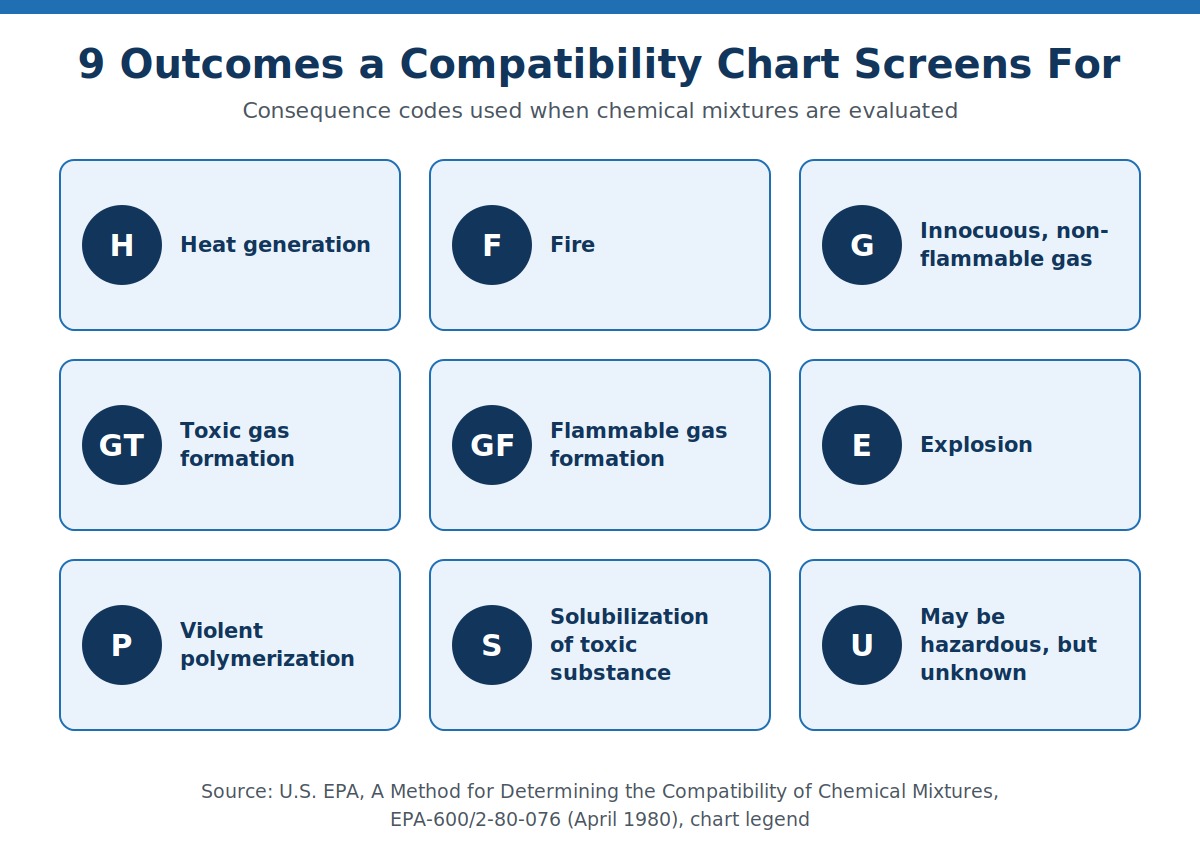
Some incompatibilities are well documented, and they explain why a documented review comes first. The table below lists examples that blending teams are trained to recognize.
| Combination | Potential Result | Why Early Screening Matters |
|---|---|---|
| Hypochlorite bleach with ammonia-containing products | Release of irritating chloramine vapors | Cleaning concentrates often contain several reactive ingredients at once |
| Hypochlorite bleach with acids | Release of chlorine gas | A pH adjustment meant to improve performance can create a hazard |
| Strong oxidizers with organic solvents | Rapid heat, fire risk, or pressure build-up | Solvent-based degreasers and oxidizing additives should never be paired without testing |
| Concentrated acids with concentrated bases | Strong exothermic reaction and splashing | Addition order and cooling must be planned before scale-up |
| Surfactants with incompatible salts or electrolytes | Cloudiness, layering, or loss of viscosity | Visible only after hours or days, so it needs a timed observation window |
Published reactivity data can flag many of these pairings in advance. A free reactivity prediction tool built for responders and planners shows which hazards, such as heat or gas generation, may arise when two substances meet. It is a useful starting point for a formulation review, though it does not replace hands-on bench evaluation of your actual blend.
Core Parameters Evaluated During Pre-Blend Formulation Screening
A thorough review does not rely on a single measurement. It combines several tests that each reveal a different way a formula can fail. Together they describe how the product will behave during blending, filling, storage, and use.

pH Stability and Drift
pH determines whether a formula stays stable or slowly changes character. A shift can alter cleaning performance, deactivate an active ingredient, or make a mixture more corrosive than intended. In concentrated industrial products, even a small drift can contribute to container damage or an unsafe handling condition. Testing at the start of the study and again after aging establishes a baseline and shows how well the formula buffers itself.
Viscosity and Flow Behavior
Viscosity tells you whether the product pours, pumps, and disperses the way your customers expect. Think of it like concrete slump: too thin and the product migrates or leaks, too thick and it will not move through dispensing equipment. Measuring viscosity at several temperatures confirms that the formula flows properly in a cold warehouse as well as on a warm production floor. This matters especially for surfactant-based cleaners, which can thicken or thin sharply as concentration and temperature change.
Thermal Reactivity and Gas Evolution
Some ingredient combinations release heat, generate gas, or build pressure as they interact. Technicians monitor temperature and watch for bubbling or venting during small-scale mixing, then repeat the test with the intended addition order and rate. This is particularly relevant for car wash concentrates and for solvent-heavy degreasers, where oxidizing and organic components can share the same formula.
Emulsion and Phase Stability
Emulsions combine ingredients that do not naturally stay mixed, so they depend on surfactants and mixing energy to hold together. The failure mode is quiet. A batch can look perfect at the end of blending and then separate into distinct layers on a shelf. Timed observation, centrifuge screening, and temperature cycling reveal weak emulsions early. Teams developing emulsion-based products benefit most from this step.
Freeze-Thaw and Accelerated Aging
Products rarely live at room temperature. They are stored in unheated buildings, loaded onto trucks in summer heat, and delivered in winter. Freeze-thaw cycling and elevated-temperature aging compress months of real-world exposure into a short evaluation window. A formula that separates after one freeze or darkens after a week of heat is far better discovered in a lab than in a customer complaint.
Summary of Core Tests
| Test | What It Reveals | Problem It Prevents |
|---|---|---|
| pH measurement over time | Chemical stability and buffering strength | Drift that weakens performance or increases corrosivity |
| Viscosity at multiple temperatures | Flow, pumping, and dispersion behavior | Leaking, clogging, or poor dispensing |
| Thermal and gas monitoring | Heat release and pressure generation | Exothermic events and pressurized containers |
| Emulsion and phase observation | Separation, creaming, or precipitation | Non-functional layers on the shelf |
| Freeze-thaw and heat aging | Resilience across storage and transit conditions | Permanent separation, gelling, or discoloration |
Material Compatibility Testing for Packaging and Equipment
A formula can pass every raw material test and still fail because it attacks its own container. Material compatibility testing evaluates how the finished product interacts with drums, totes, bottles, closures, and the equipment used to blend and fill it. A product that degrades its packaging has simply moved the failure to a warehouse, a truck, or a customer facility.

How Chemical Compatibility Testing Protects Containers and Closures
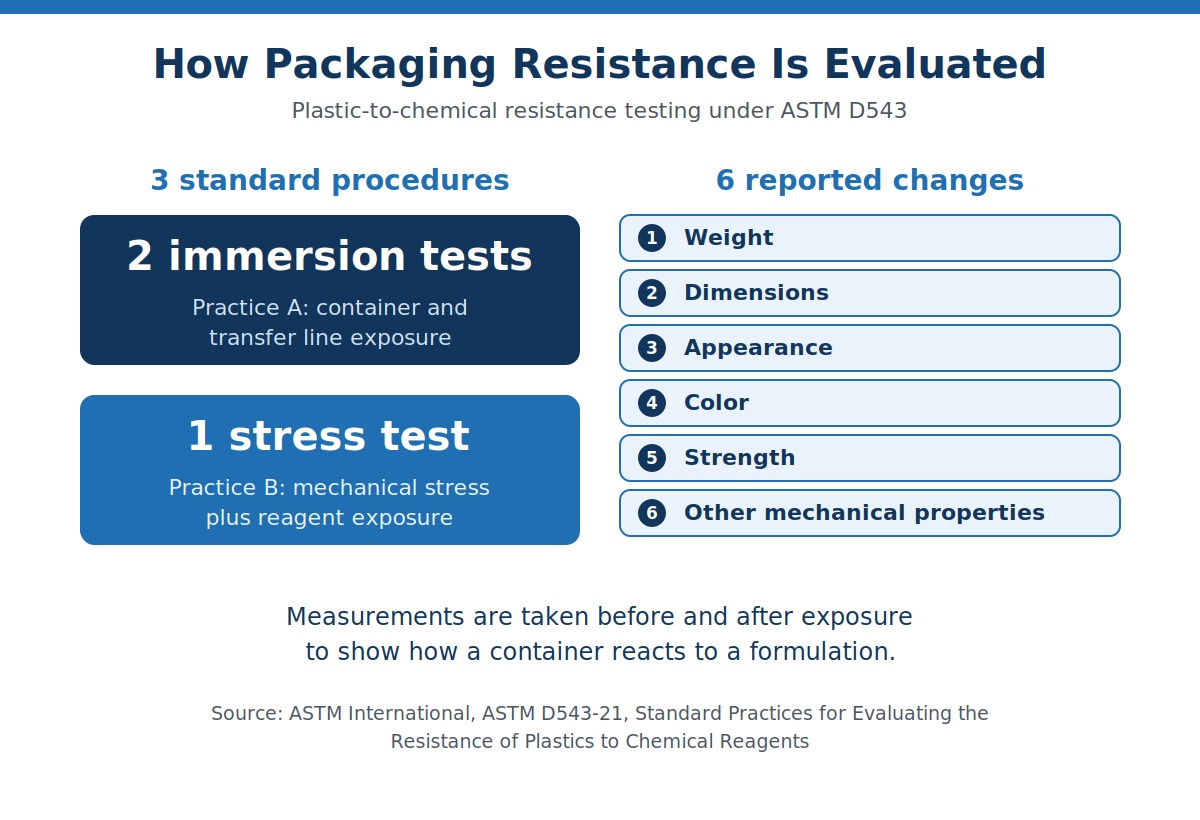
Packaging evaluation exposes sample containers or material coupons to the finished formula under controlled, often elevated, temperatures. The samples are weighed, measured, and inspected before and after exposure. Recognized immersion and stress-cracking practices look for changes in weight, dimensions, appearance, color, and strength, which together show whether a container will hold up through its intended shelf life.
Plastic Drums, Totes, and Bottles
Plastics can soften, swell, craze, or crack when certain solvents, surfactants, or fragrance oils sit against them for weeks. Stress cracking is especially tricky because a container can look fine until it is handled or stacked. Permeation is another concern, since volatile ingredients can migrate through container walls and cause weight loss or odor problems.
Steel Pails and Lined Containers
Acidic and alkaline formulas can corrode bare steel, and chloride-bearing products can attack many metals. Lined containers add protection, but the liner itself must resist the formula. Evaluating both the liner and any exposed seams or fittings prevents leaks that only show up after a long storage period.
Seals, Gaskets, and Closures
Small components cause outsized problems. O-rings, bung gaskets, and cap liners can swell, shrink, or harden in contact with a formula, and a failed seal is a leak waiting to happen. Testing these parts alongside the container confirms the entire closure system works as a unit.
| Packaging Component | Typical Concern | What Testing Confirms |
|---|---|---|
| Plastic drums and totes | Softening, swelling, stress cracking, permeation | Container keeps its shape, weight, and strength through shelf life |
| Steel pails and drums | Corrosion from acidic, alkaline, or chloride-bearing formulas | Bare metal or lining resists the formula without pitting |
| Liners and coatings | Blistering, peeling, or dissolving | Lining stays intact and does not contaminate the product |
| Gaskets, O-rings, and cap liners | Swelling, shrinking, or hardening | Closure stays leak-resistant after exposure |
Once a container is chosen, the next question is how the filled product will be handled. Programs that include hazmat-ready containers need verified material compatibility before labeling and shipping rules can be applied with confidence. Brands running recurring fill schedules can also lock in an approved container through contract fill and pack programs, so every run uses the same tested components.
The Operational Cost of Skipping Pre-Production Screening
The cost of an untested formula shows up in several ways, and most of them are avoidable. A failed batch means lost raw materials, lost labor, and lost production time. A container that fails in storage means damaged inventory and possible cleanup. A product that separates in a customer’s hands means returns, replacement shipments, and a damaged reputation.
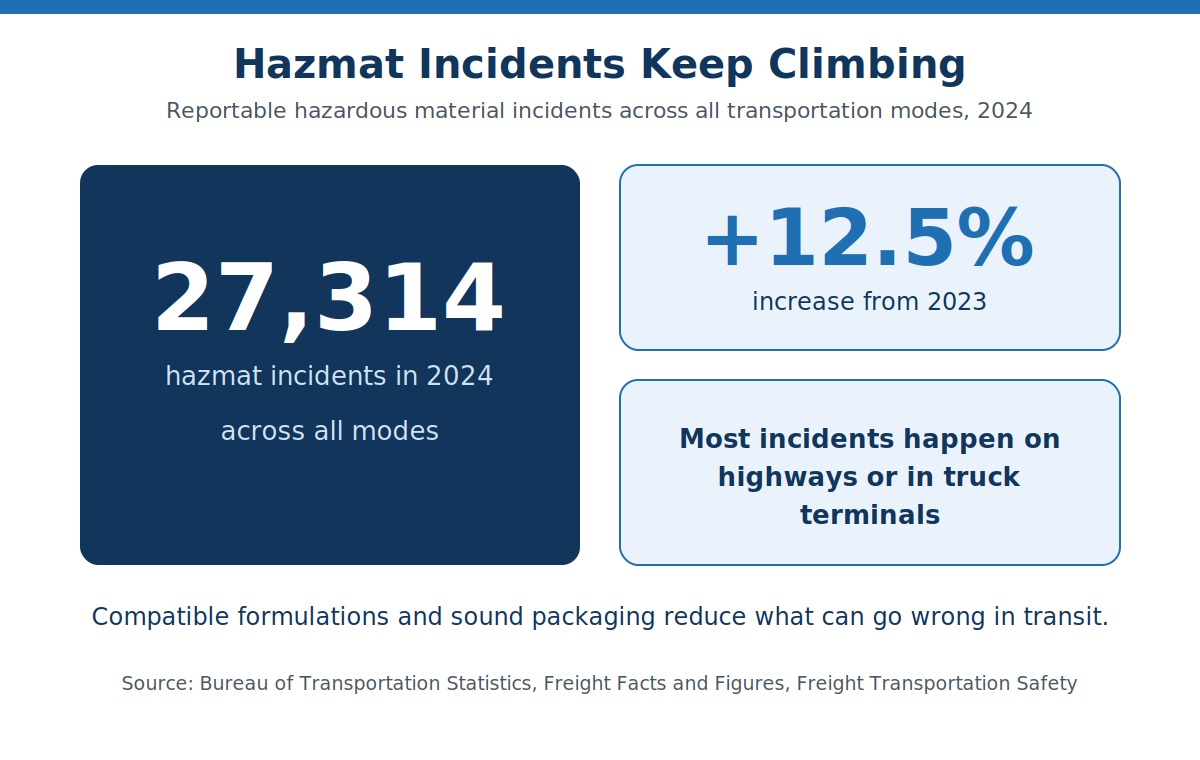
Transportation adds another layer. Hazardous material incidents across all transport modes reached 27,314 in 2024, up 12.5 percent from 2023, and most occur on highways or in truck terminals. A compatible formula in a verified container is far less likely to contribute to that kind of event.
Warehouse and Storage Risks
Storage conditions can quietly undermine a product that was stable on the day it was made. Heat, cold, light, and time all give slow reactions a chance to progress. Reviewing how a finished product will be held matters just as much as reviewing how it will be blended, which is why storage and outbound shipping conditions belong in the early conversation.
Planning for Realistic Timelines
Early testing also makes schedules more reliable. When stability data, packaging approvals, and addition order are settled in advance, production runs move forward without surprise holds. Customers who share their target launch dates up front let the team plan the right number of aging checks and decide which tests can run in parallel.
Reformulation and Ingredient Substitution Strategies
Compatibility work is not only a safeguard. It is also the way to change a formula with confidence. Ingredient shortages, cost pressure, and evolving customer expectations all push brands to adjust what goes into a product, and each change needs the same discipline as the original design.
Validating Substitute Ingredients
Swapping one ingredient for another can change viscosity, foaming, stability, color, and corrosivity all at once. Running the substitute through the same battery of tests as the original shows whether the finished product performs equivalently. Brands building private label product lines often rely on this step to keep multiple formulas consistent when suppliers change.
Reducing Hazard at the Source
Input substitution replaces a more hazardous raw material with a safer one without simply diluting the waste stream. Examples include moving from a harsh solvent to a lower-VOC or bio-based alternative, or replacing an unstable additive with a more robust one. Compatibility screening is what proves the safer option actually works in the finished product. The same logic applies to specialty chemical formulas where performance requirements are tight and small changes can have large effects.
How ITC Approaches Intake-to-Feasibility Review
Industrial Technology Corporation is a family-owned manufacturer with more than 40 years of experience blending and packaging chemical products for customers nationwide. Its intake-to-feasibility process is designed to confirm that a formula can be made safely and consistently before production begins.
- Formula intake: Share your ingredient list, concentrations, target specifications, and intended packaging.
- Raw material review: Each ingredient is reviewed for compatibility, handling needs, and known hazards.
- Bench-scale screening: Small test batches are evaluated for pH, viscosity, thermal behavior, and phase stability.
- Packaging evaluation: The formula is checked against the containers and closures planned for production.
- Formula adjustment: If a problem appears, the team recommends changes to ingredients, order of addition, or packaging.
- Production planning: Approved formulas move into scheduling with documented parameters and realistic timelines.
Because the review covers both formula and container, customers avoid the common problem of solving one issue while creating another. The same team understands the industries ITC supports, so recommendations reflect how products are actually used, stored, and shipped in each market.
Frequently Asked Questions About Chemical Compatibility Testing
What is the difference between chemical compatibility and chemical stability?
Chemical compatibility describes how two or more materials interact when combined, including whether they cause reactions, separation, or damage. Chemical stability describes how a single finished formulation holds its properties over time under conditions such as heat, cold, and light. Compatibility is evaluated first, during feasibility review, and stability testing then continues across the intended shelf life.
How does temperature affect compatibility during storage and shipping?
Extreme temperatures can speed up reactions, weaken emulsions, and cause ingredients to precipitate. Freeze-thaw cycling and heat aging recreate those conditions in a controlled way. A formula that passes at room temperature but separates after a single freeze is not truly stable, so temperature testing is a standard part of a thorough review.
What is a common example of chemical incompatibility in blending?
Mixing hypochlorite bleach with ammonia-containing products releases irritating chloramine vapors, and mixing bleach with acids can release chlorine gas. In industrial blending, strong oxidizers combined with organic solvents, or acids added to bases without controlled cooling, can create dangerous heat, gas, or pressure. Pre-production screening is designed to catch these interactions before they reach a mixing vessel.
How do you know if a formula is compatible with plastic packaging?
Plastic samples such as HDPE or PET are exposed to the formula, often at elevated temperatures, and then inspected for swelling, softening, stress cracking, discoloration, and weight change. This accelerated approach compresses months of storage into a short evaluation window and gives reliable evidence about long-term container performance before any drums are filled at production scale.
Is bench-scale testing enough, or is scale-up testing needed too?
Bench-scale testing identifies most chemistry and packaging problems early, but mixing energy, heat transfer, and addition rates change in larger vessels. A well-run program treats the bench evaluation as the first gate and then confirms performance during the first production-scale batch with in-process checks and finished-product testing.
When should compatibility testing be repeated?
Repeat screening any time an ingredient, supplier, concentration, or container changes. Even a change that seems minor, such as a new grade of surfactant or a different drum liner, can alter how a formula behaves. Treating each change as a mini feasibility review keeps product quality consistent from one production run to the next.
Start Your Formulation Review
If you are preparing to scale a liquid or powder product, confirming compatibility first is the most reliable way to protect your investment. To discuss your formula, your packaging plans, and your timeline, contact the ITC team today. You can also learn more about the company behind the process at Industrial Technology Corporation.