
What Is Agricultural Chemical Manufacturing Used For?
Agricultural chemical manufacturing is the operational backbone of modern food production, and its scope runs far wider than most product managers and distributors assume. The common association with pesticide synthesis misses much of what the industry makes: primary crop nutrients, soil conditioners, post-harvest treatments, livestock facility sanitizers, and heavy-duty equipment maintenance chemicals. Each category carries its own formulation requirements, regulatory obligations, and supply chain demands.
The scale of the work explains why it takes serious manufacturing infrastructure. According to the U.S. Environmental Protection Agency, roughly half a million tons of pesticides, 12 million tons of nitrogen, and 4 million tons of phosphorus fertilizer are applied to crops in the continental United States every year. Moving those volumes reliably requires precise formulation chemistry, dependable blending systems, and packaging operations built to handle hazardous materials at production scale.
That is where a specialized chemical blending and packaging partner like Industrial Technology Corporation becomes part of the picture, turning proprietary formulas into consistent, compliant, ready-to-ship products.
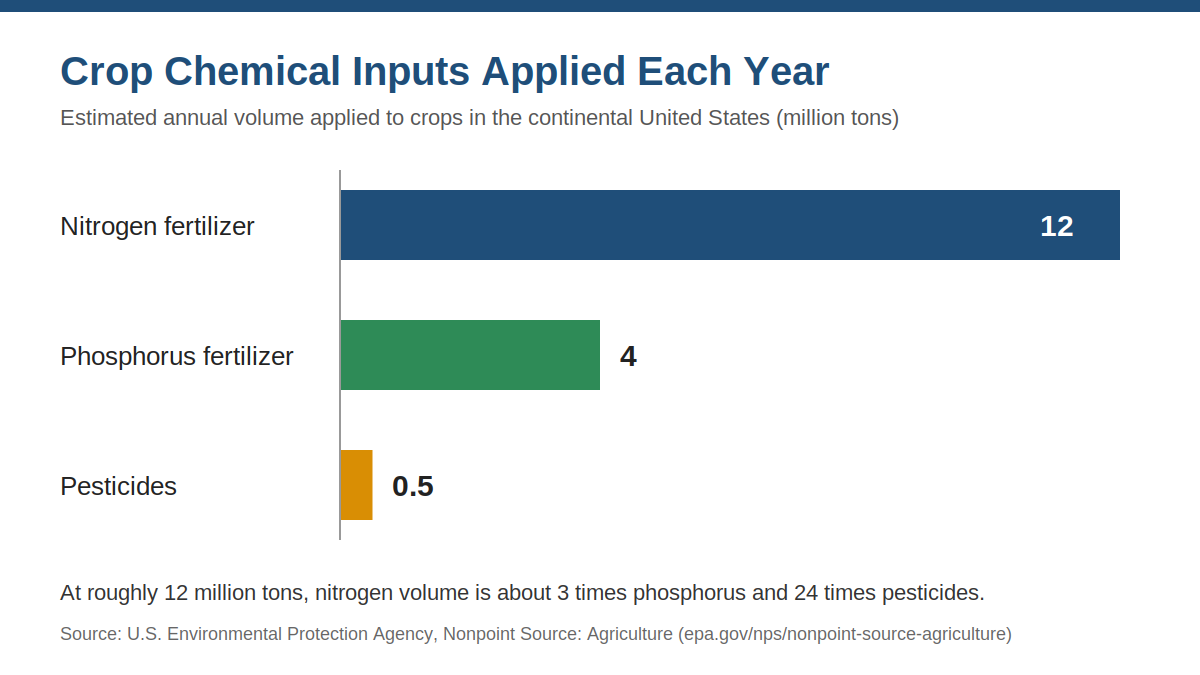
Data source: U.S. Environmental Protection Agency, Nonpoint Source: Agriculture
What Does Agricultural Chemical Manufacturing Produce?
The category is broader than field sprays and fertilizer bags. The table below shows the major product groups and why formulation precision matters in each one.
| Product Group | Common Examples | Formulation Priority |
|---|---|---|
| Crop nutrients | Nitrogen, phosphate, potash, and sulfur blends | Stable concentration and compatibility with application equipment |
| Crop protection support | Surfactants, adjuvants, and carrier systems | Emulsion stability and consistent dilution |
| Facility sanitation | Sanitizers and disinfectants for dairies, egg processing, and livestock housing | Pathogen kill efficacy at calibrated active ingredient levels |
| Equipment maintenance | Degreasers, road tar removers, and aluminum brighteners | Cleaning power without damaging paint, anodized finishes, or fittings |
| Post-harvest treatments | Storage and commodity quality products | Residue control and handling safety |
Agricultural Chemical Manufacturing for Crop Nutrition
Corn and soybean programs lean on the primary macronutrients nitrogen (N), phosphate (P₂O₅), and potash (K₂O), along with secondary nutrients like sulfur (S). The challenge is getting those nutrients into stable forms that perform the same way across different soil types, water sources, and spray or fertigation equipment.
Liquid formulations are especially demanding. Concentrations must stay accurate from the first gallon to the last, and the product has to remain pumpable and stable through a long application season. Experienced liquid blending is what keeps a nutrient concentrate within its stated analysis, batch after batch.
Dry nutrient and micronutrient products bring different concerns, including particle size, flowability, and uniform distribution of small-percentage ingredients. A reliable powder blending process prevents the segregation that leaves one bag rich in an ingredient and the next bag short.
Agricultural Chemical Manufacturing for Cleaning and Maintenance Products
Facility sanitation and equipment maintenance are a large and often underserved part of the agricultural supply chain. Egg processing plants, dairies, grain handling facilities, and livestock operations all work under strict sanitation expectations, and those expectations leave no room for improvised cleaning protocols or consumer-grade products.
Sanitizers and Disinfectants for Livestock and Processing Facilities
Contamination risks in these environments are real, and the cost of a sanitation failure reaches well beyond a failed inspection. Purpose-built industrial cleaning chemical blending accounts for active ingredient concentrations, surfactant selection, and compatibility with the surfaces and drainage systems found in agricultural settings. A cleaner that works well on stainless steel tanks may attack aluminum fittings or leave residues that interfere with food-contact surfaces, so formulation specificity matters.
Heavy-Duty Degreasers and Surface Treatments for Farm Equipment
Tractors, harvesters, and transport vehicles collect road tar, soot, hydraulic fluid, and baked-on grime. Effective degreaser contract blending produces products that cut through that buildup without stripping protective coatings.
Common facility and equipment applications include:
- Facility sanitizers and disinfectants: Formulated for egg processing, dairies, and livestock housing, with concentrations calibrated for pathogen kill in those specific environments.
- Equipment degreasers: Engineered to remove road tar, soot, and hydraulic fluid from tractors, harvesters, and trucks without damaging painted or anodized surfaces.
- Post-harvest and livestock treatments: Specialized products that help maintain commodity quality in storage and support sanitation in livestock facilities.
- Aluminum brighteners: Acid-based or chelated chemistry for trailers, RV rooftops, and equipment panels where oxidation and staining build up.
Brands that want to grow their cleaning and sanitation lines without building a plant of their own can do so through private label chemical blending, bringing consistently formulated products to market under their own name.
How Agricultural Chemical Blending Supports Farm and Facility Products
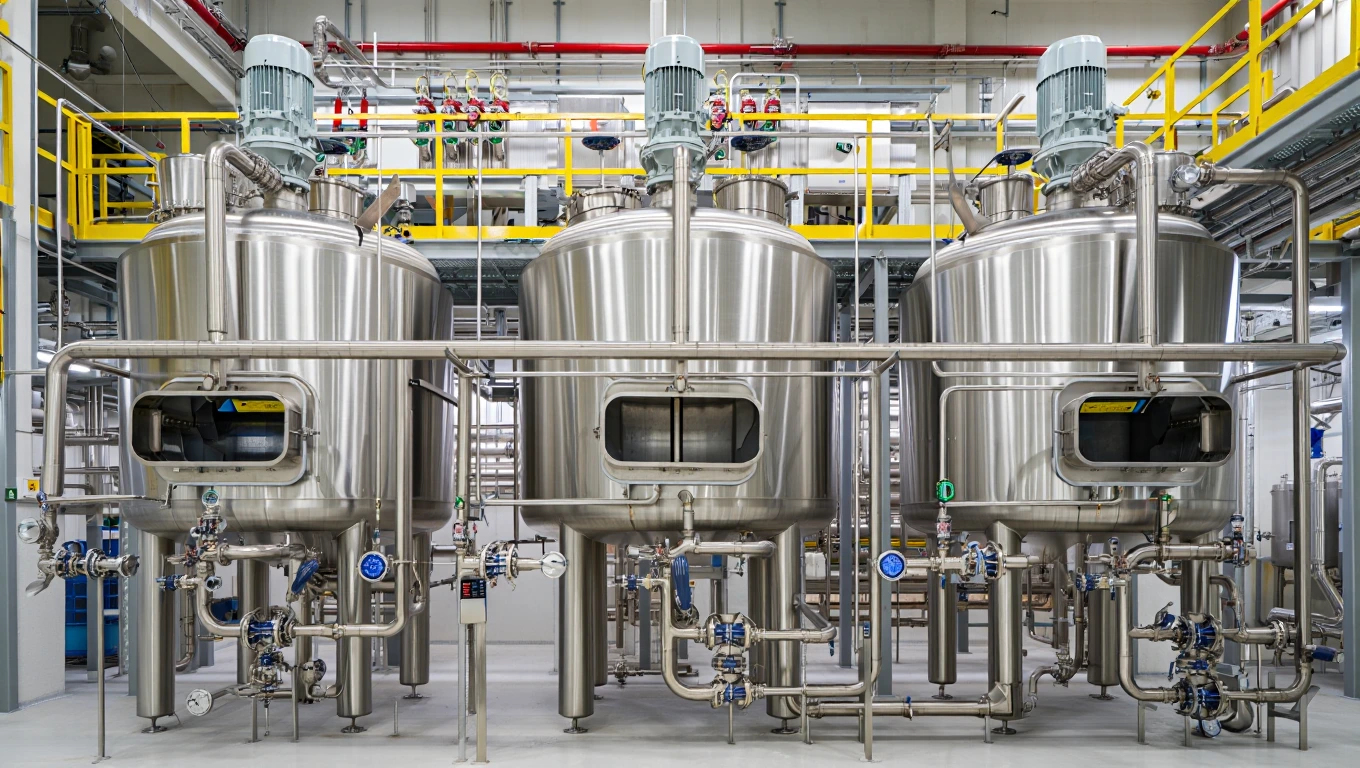
The gap between a stable bench formulation and a production-ready product is where many agricultural brands first run into operational friction. Blending is not just combining ingredients in the right ratios. It means managing pH stability across temperature ranges, keeping surfactant systems intact under the shear of high-volume mixing equipment, and confirming that active ingredients stay available instead of binding to carrier compounds.
Scaling From Bench Batches to Production Runs
Moving from a 5-gallon development batch to a 5,000-gallon production run introduces variables that bench chemistry does not predict well: heat generated during mixing, emulsifier behavior under extended agitation, and the settling characteristics of suspension concentrates in large containers. These are the root cause of products that worked in trials but perform inconsistently in the field.
Think of custom toll blending like a recipe that has to taste the same whether it is cooked for four people or four hundred. Adjusting ratios for surfactant blending and emulsion blending at scale is a skill, and a partner with production-scale experience brings it to the formulation process from the start, which means fewer surprises between development and commercial launch.
Blending and Packaging Support for Seasonal Demand
Agricultural chemical demand does not follow a fixed schedule. Planting windows compress weeks of input demand into days, and a biosecurity event at a poultry or swine operation can create urgent, high-volume sanitizer orders with almost no lead time. Brands that handle these spikes without supply disruptions have usually worked through production scaling and packaging logistics with their manufacturing partner before the season begins.
Packaging Formats in Agricultural Chemical Manufacturing
Packaging is where many brands underestimate the complexity. A formulation that ships efficiently in 275-gallon totes for large commercial operations may need to be repackaged in 5-gallon pails for distribution or 1-gallon jugs for direct-to-farm sales. Each format needs its own fill-line setup, label compliance, and closure specification.
| Container | Typical Use |
|---|---|
| 1-gallon jugs | Direct-to-farmer and retail sales |
| 5-gallon pails | Route delivery and distributor stocking |
| 55-gallon drums | Facility sanitation and equipment maintenance programs |
| 275-gallon totes | Large commercial and cooperative accounts |
| Bulk tankers | Distribution hub replenishment |
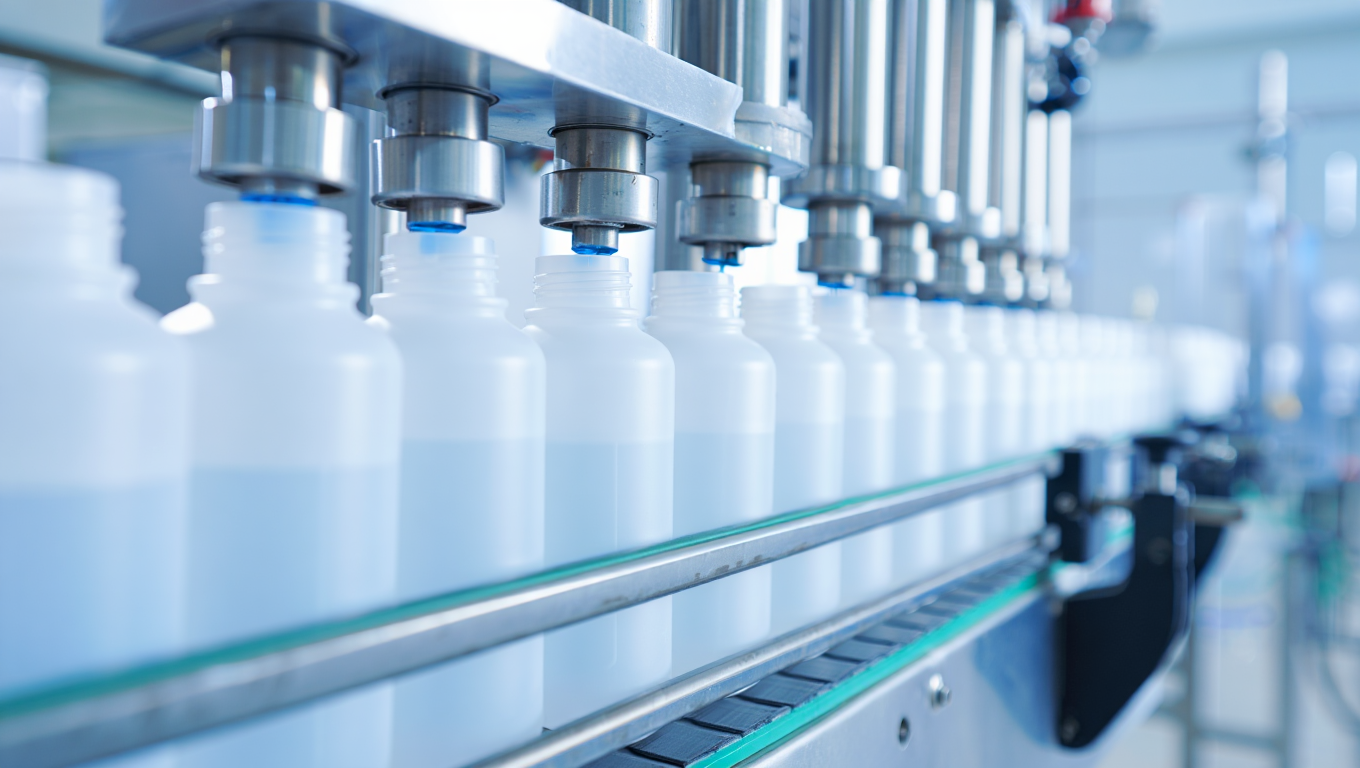
Dependable contract chemical packaging lets a brand move between small specialty runs and high-volume seasonal production without carrying excess finished-goods inventory. Direct shipping and staging through warehousing and shipping removes handling steps between production and the farm gate when application windows are tight.
The core advantages of flexible blending and packaging support include:
- Logistical flexibility: Smooth transitions between small-batch runs and high-volume seasonal production.
- Container diversity: Liquid and powder formulations packaged to match distributor and end-user preferences.
- Supply chain integration: Warehouse staging and direct shipping that shorten the path from production to the customer.
Why Consistent Production Matters for Agricultural Chemical Brands
For agricultural chemical brands, formulation drift is an immediate liability. A batch of liquid fertilizer that is measurably off its stated nitrogen concentration does not simply underperform. It can injure crops, trigger warranty claims, and damage distributor relationships that took years to build. The same applies to equipment cleaners: a degreaser that is too strong strips protective coatings, and one that is too weak leaves contamination behind.
Consistency gets harder as production scales and raw material sources shift. Surfactant lots vary in their HLB characteristics, solvent batches carry trace impurities that affect viscosity, and active ingredient levels in incoming materials move within their specification ranges. If the blending process does not adjust for those variances in real time, the finished product drifts with them.
Climate adds another layer. A liquid concentrate that pours smoothly at 65°F may be too thick to pump at 40°F, or may separate after sitting in a 90°F warehouse. Locking in those performance limits during development and verifying them batch after batch is what separates a product that earns repeat orders from one that generates returns.
Proprietary formulas are real competitive assets, so brands also need a manufacturing partner that treats formula confidentiality as a firm operating standard, not a marketing claim.
Quality Control for Repeatable Agricultural Chemical Production
Batch-to-batch consistency depends on testing that goes well beyond a final pH check before shipment. A solid protocol typically includes:
- Viscosity monitoring: Checks at multiple points in the blend catch surfactant or solvent variance before it becomes a finished-product defect.
- Active ingredient verification: Titration, spectrophotometric analysis, or chromatography, depending on the chemistry, confirms the product delivers what the label claims.
- Retention samples: Saved samples from every batch give a reference point for investigating field complaints and support traceability.
- Documentation: Batch records that support distributor audits and compliance reviews.

The analytical equipment behind these protocols is a major capital investment that most agricultural brands do not need to own. A partner with in-house testing carries that burden and supplies the documentation trail. When quality verification is tied to filling and labeling, the consistency achieved in the blend carries through to the finished unit.
Navigating the Agricultural Supply Chain and Compliance
Agricultural chemical brands operate under several overlapping federal frameworks, and a gap in any one of them can delay a launch or put a registration at risk. Key obligations include:
- Pesticide registration: Products making pest-control claims must be registered before commercial distribution, which requires formulation data, efficacy evidence, and safety assessments.
- Waste and environmental safety: Chemical waste generated during manufacturing must be managed under hazardous waste rules, and water monitoring data informs reviews of how formulations behave in the environment.
- Transport labeling and documentation: Shipping hazardous agricultural chemicals requires compliant labels, safety data sheets, and shipping papers.
Because transport rules apply the moment a product leaves the building, hazmat chemical packaging works best when it is built into the production workflow instead of handled at the shipping dock. A capable partner also absorbs safe storage, waste handling, and safety data sheet management, so brands can focus on sales and market development without surrendering control of the product.
How Toll Blending Gives Agricultural Brands a Practical Path to Market
Toll manufacturing is an arrangement in which a specialized manufacturer blends and packages raw materials into finished products according to the client’s own formula. The brand keeps ownership of the intellectual property and the customer relationship, while the manufacturer supplies the equipment, trained operators, and quality systems.
For crop nutrition, facility sanitation, and equipment care brands, this model removes the capital cost of tanks, filling lines, and laboratory equipment. A full-service toll chemical blending and packaging program handles everything from raw material receiving to finished, labeled product, and agricultural toll blending experience helps match formulations to the demands of seasonal distribution. The same approach scales across the full range of chemical blending services, from a first small order to a sustained production program.
Frequently Asked Questions About Agricultural Chemical Manufacturing
What is the definition of an agrochemical?
An agrochemical is any manufactured chemical compound used to improve agricultural productivity, protect crop health, or maintain farm facilities. The category includes primary crop nutrients (nitrogen, phosphate, potash), soil conditioners, pesticides (herbicides, insecticides, fungicides), and specialized facility sanitizers.
What is the difference between intensive farming and organic farming?
Intensive farming relies on targeted, high-volume inputs such as synthetic fertilizers and pesticides to maximize yields on a given acreage. Organic farming avoids synthetic chemical applications and relies on biological pest control, crop rotation, and organic soil amendments. Conventional production still accounts for most of the food supply, which is why consistent chemical manufacturing remains essential.
What are the primary pesticide application safety guidelines?
Core safety practices include wearing proper personal protective equipment, following label dilution ratios exactly, preventing drift during application, and disposing of waste through compliant hazardous waste channels. Transport of these products is governed by separate hazardous materials rules.
How does custom chemical blending benefit agricultural brands?
Custom blending lets brands adjust standard formulations to specific soil profiles, crop needs, or climate conditions. It ensures liquid and powder concentrates dilute properly and rinse clean without clogging equipment, while protecting the brand’s proprietary formula.
What is agricultural chemical toll manufacturing?
Toll manufacturing, also called toll blending, is an arrangement where a specialized manufacturer processes, blends, and packages raw materials into finished products using a client’s proprietary formula. Agricultural brands gain access to production equipment, quality control systems, and compliance expertise without the expense of building their own facility.
What container sizes are available for agricultural chemical products?
Liquid and powder products can be packaged in sizes ranging from 1-gallon jugs and 5-gallon pails to 55-gallon drums, 275-gallon totes, and bulk tankers, depending on how the product is distributed and used.
Contact Us Today
Agricultural chemical manufacturing is a technically demanding, heavily regulated discipline that extends well beyond field sprays and fertilizer bags. The brands that build lasting positions, whether in crop nutrition, facility sanitation, or equipment maintenance, treat formulation consistency, compliant packaging, and supply chain agility as core strengths. Seasonal demand does not wait for a manufacturing partner to get organized, and formulation shortcuts do not hold up under scrutiny.
Industrial Technology Corporation is a family-owned blending and packaging partner with more than 40 years of experience. If you are ready to scale an agricultural product line, share your formulation, packaging, and toll blending needs with our team.