
Who Needs an Industrial Cleaning Chemical Manufacturer?
Regional distributors, private-label brands, commercial cleaning suppliers, facility maintenance companies, and industrial manufacturers that hit supply chain ceilings or formulation limits all need a dedicated industrial cleaning chemical manufacturer. The real question is not whether outsourcing makes sense at scale. It is whether the drag of in-house mixing or fragmented sourcing is already costing more than a transition would.
Mixing in-house pulls capital, labor, and attention away from selling. A specialized blending partner such as Industrial Technology Corporation extends a brand’s operational reach without requiring it to build tanks, ventilation, and safety infrastructure of its own.
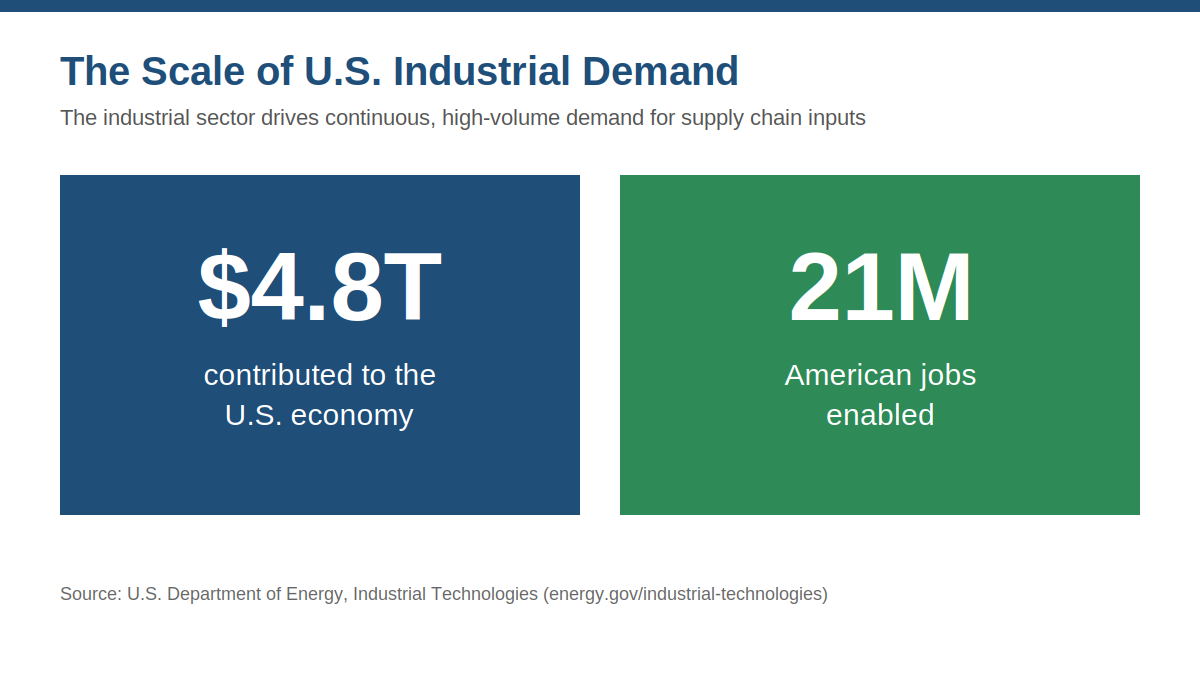
Data source: U.S. Department of Energy, Industrial Technologies
Who Needs an Industrial Cleaning Chemical Manufacturer?
Five business types consistently benefit from a professional blending partner:
- Regional distributors: Managing inconsistent raw material supply and long lead times.
- Private-label brands: Needing production capacity without capital investment.
- Commercial cleaning suppliers: Whose product lines have outgrown their current sourcing arrangements.
- Facility maintenance companies: Requiring application-specific formulations.
- Industrial manufacturers: Whose cleaning requirements are too specialized for off-the-shelf chemistry.
Operational bottlenecks are usually the first concrete signal. When a distributor’s lead times stretch because one raw material is back-ordered, or a private-label brand cannot scale a SKU because its supplier has hit a capacity ceiling, the case for a dedicated manufacturer stops being theoretical.
The underlying demand is enormous. The U.S. Department of Energy reports that the industrial sector contributes $4.8 trillion to the economy and enables 21 million jobs, which generates steady, high-volume demand for chemical supply chains that can keep pace with production schedules.
Signs an Industrial Cleaning Chemical Manufacturer Is the Next Step
Supply chain stability at that level takes more than a vendor relationship. It takes a manufacturer with deep raw material sourcing, quality systems that catch batch variation before product ships, and the logistics to fill orders across multiple packaging configurations. Warning signs that a business has outgrown its current setup include:
- Back-orders on a single raw material that stall finished product.
- A supplier that cannot add capacity for a growing SKU.
- Inconsistent batches that trigger customer complaints or returns.
- Staff time going to mixing, labeling, and paperwork instead of sales.
- Cleaning problems that catalog products cannot solve.
For businesses that have outgrown a local chemical supplier, industrial cleaning chemical blending at a dedicated facility closes the gap between what a brand can sell and what it can reliably produce.
Compliance pressure compounds the sourcing problem. Growing businesses face an expanding set of rules covering chemical labeling, Safety Data Sheets, and VOC limits. Managing those requirements internally demands dedicated staff, ongoing monitoring, and documentation systems that most distributors and private-label brands are not built to maintain. A professional partner absorbs that burden as part of the production relationship, not as a separate line item.
Efficiency matters too. A manufacturer with strong inbound sourcing and outbound logistics gives customers more predictable pricing and delivery windows, which is valuable when inventory is spread across several distribution points.
Products an Industrial Cleaning Chemical Manufacturer Can Produce
A professional blending partner makes liquid and powder formulations across many categories, including car wash concentrates, fleet cleaning solutions, heavy-duty degreasers, floor care products, and specialty blends for particular industrial soils. Unlike a catalog supplier with fixed SKUs and fixed performance, a manufacturer works from your specifications or develops formulations with you.
Customization lets brands compete on performance instead of price. A distributor serving food processors needs a different alkaline cleaner than one serving metal fabrication shops, even if the two look similar on a spec sheet. Configuring surfactant packages, alkaline builder concentrations, and solvent ratios to match specific surfaces and soils is what separates a manufacturing partner from a reseller. It also lets a brand expand its line without in-house R&D or lab staff.
| Product Category | Typical Use | Formulation Focus |
|---|---|---|
| Heavy-duty alkaline degreasers | Manufacturing equipment and production line maintenance | Solvent blend and surfactant balance for baked-on grease |
| Acidic cleaners and brighteners | Scale removal, rust inhibition, and aluminum brightening on fleet vehicles | pH control that cleans without etching metal |
| Neutral-pH floor finishes and strippers | High-traffic commercial facilities | Leveling, durability, and removability |
| Vehicle wash detergents | Touchless and brush-style commercial car washes | Foam, dwell time, and rinse performance |
Adjusting surfactant ratios in any of these categories decides whether a product sheets off a surface quickly or clings long enough to penetrate baked-on grease and road film. End users notice that difference immediately, yet it takes precise formulation control to deliver it consistently. A capable surfactant blending process is where that control starts.
Industrial Technology Corporation has operated as a family-owned contract manufacturer for more than 40 years. For brands weighing outsourced production, the model is straightforward: chemical blending services run from formula intake to finished goods, eliminating the capital cost of blending tanks, ventilation systems, and specialized safety equipment while letting volume scale up or down with demand.
Industrial Cleaning Chemical Manufacturer Support for Degreasers and Detergents
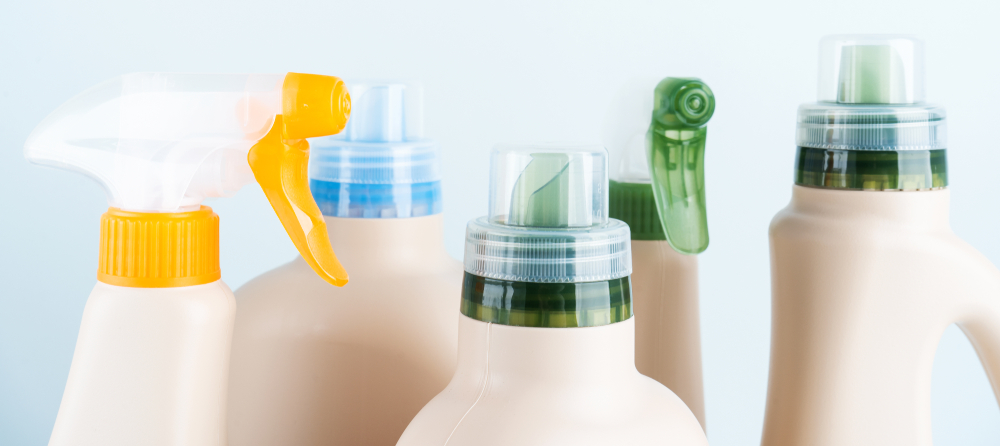
Degreasers are among the most technically demanding products a manufacturer handles, and the challenge goes beyond mixing surfactants with alkaline builders. Cutting through heavy hydrocarbons, road tar, and soot without damaging aluminum, painted surfaces, or rubber seals calls for careful solvent selection, pH management, and chelating agents that keep soils suspended instead of redepositing on the surface. Experienced degreaser contract blending covers the full path from initial specification through batch production and quality verification.
Concentrate design is one of the most practical decisions in this category. A product engineered to work at a leaner dilution reduces cost per use for the end user and cuts shipping weight, which improves freight economics for the distributor. Getting there takes surfactant chemistry expertise and iterative testing, not just a formula tweak.
Fleet Wash and Commercial Detergent Formulations
Fleet cleaning adds another layer of complexity. Concentrates must brighten oxidized aluminum wheels and lift road film without etching metal or leaving residue that speeds corrosion, and the formulation window is narrower than it looks. Commercial detergent applications for fleet maintenance typically require:
- High-pH alkaline detergents: For heavy road grime and organic soils on vehicle exteriors.
- Low-pH acidic brighteners: For oxidized aluminum and brake dust removal.
- Surfactant-rich foaming agents: Engineered for touchless systems where dwell time and foam coverage do the mechanical work.
Brands serving wash operators can go deeper with dedicated car wash chemical blending, tuned to the equipment and water conditions their customers run.
Concentrated Cleaners, Floor Care Products, and Specialty Blends
Shipping water is a waste that concentrates eliminate. The table below shows how much ready-to-use solution a single 5-gallon pail can produce at common dilution ratios.
| Dilution Ratio (concentrate to water) | Approximate Ready-to-Use Volume from 5 Gallons |
|---|---|
| 1:20 | 100 gallons |
| 1:64 | 320 gallons |
| 1:128 | 640 gallons |
A pail designed for 1:128 dilution delivers the cleaning capacity of roughly 640 gallons of ready-to-use product at a fraction of the freight cost and storage space. Distributors gain a real freight advantage, and facility operators manage inventory more precisely because less product covers more area. Concentrates are a natural fit for liquid blending, and dry concentrates can be developed through powder blending when a dissolvable format suits the application.
Viscosity is a detail that deserves more credit than it gets. A floor finish that is too thin will not level, leaving streaks and uneven sheen. A degreaser that is too thick will not move through automated dispensing equipment. A manufacturer sets these parameters to match the customer’s application method, whether hand mop, auto scrubber, pressure washer, or foam applicator, so the product performs in the field and not only in the lab.
Floor finishes, sealers, and strippers for commercial facilities are a specialty category where precision directly affects durability under heavy foot traffic. A finish that fails early in a distribution warehouse or retail space creates maintenance cost and liability that far exceed the cost of getting the chemistry right. These blends are developed through collaborative consultation, where the technical team works against the customer’s performance targets, surface type, and application conditions instead of pulling a standard formula off a shelf.
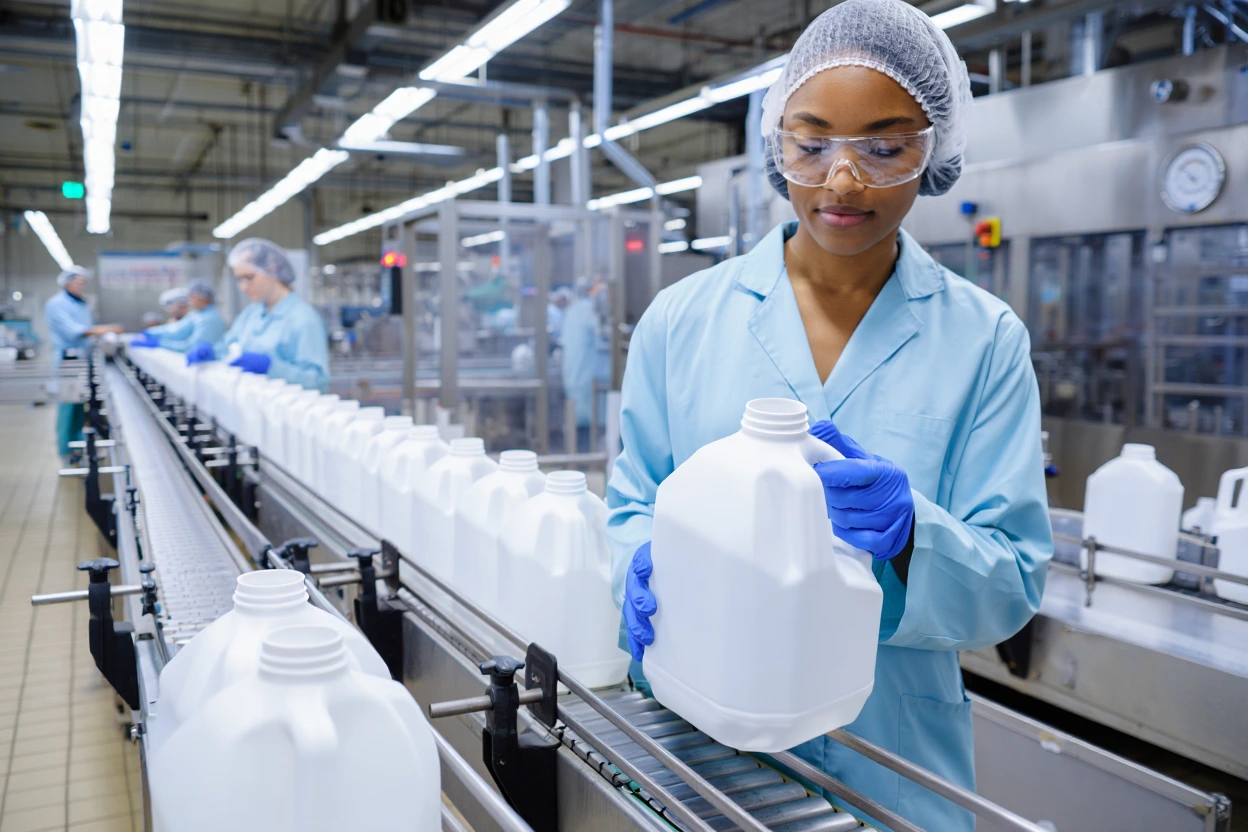
Brands that already have a formula and need professional filling, labeling, and logistics rather than development can lean on contract chemical packaging, which covers the full production-to-shipment cycle from 5-gallon pails to 275-gallon totes.
Packaging, Labeling, and Shipping for Commercial Cleaning Products
Chemical labeling and Safety Data Sheet management carry stringent federal requirements that most brands underestimate until they face a compliance gap. Safety Data Sheets follow a uniform 16-section format aligned with the Globally Harmonized System of Classification and Labeling of Chemicals, and they must be revised within three months of a manufacturer becoming aware of significant new information about a chemical’s hazards. A professional manufacturer handles those updates as part of the production relationship, protecting brands from the violations and liability that come with outdated or incomplete hazard documentation.
Turnkey packaging and shipping logistics cover the full lifecycle, from container selection through staged outbound freight:
- Custom labeling and private-label branding applied to finished containers.
- Packaging in 5-gallon pails, 55-gallon drums, and 275-gallon totes to match distributor and end-user requirements.
- Staging and preparation for outbound freight to distribution points.
Brands building their own label can combine private label chemical packaging with warehousing and shipping so finished goods leave production already staged for delivery.
How to Evaluate an Industrial Cleaning Chemical Manufacturer
When comparing potential suppliers, the criteria that matter most are technical capability, compliance infrastructure, and batch-to-batch consistency. A reliable partner will:
- Communicate clearly throughout the production cycle.
- Maintain raw material traceability from sourcing through finished goods.
- Document quality control results so customers see what they are receiving, not just an invoice and a pallet.
- Manage hazardous goods handling, which is where hazmat chemical packaging expertise becomes essential for corrosive and regulated products.
Managing packaging, labeling, and compliance in-house is a heavy burden that grows with every product added. Outsourcing lets growing brands redirect internal resources toward sales, marketing, and customer development instead of production management.
Why Outsourced Blending Works for Cleaning Chemical Brands
Capital preservation is the most immediate financial argument. Building or upgrading a blending facility means investing in mixing vessels, ventilation and exhaust, chemical storage, spill containment, and specialized safety equipment. Once committed to production infrastructure, that capital is no longer available for inventory, sales headcount, or market expansion.
Production scalability is the operational argument. An outsourced model lets brands raise or lower volumes based on real demand without carrying the fixed overhead of a facility sized for peak capacity. A private-label brand entering a new market can scale a SKU without pre-committing to a run larger than its initial distribution footprint. Brands that operate their own blending lines cannot match that flexibility, because their overhead only drops with volume, not with demand.
Ingredient safety is a third. Responsible manufacturers evaluate raw material safety and environmental impact against verified scientific data before a custom formulation reaches production, which matters for customers who must demonstrate responsible sourcing in their own supply chains.
Intellectual property protection is a reasonable concern in any toll blending conversation. Professional toll blenders protect client formulas through non-disclosure agreements and dedicated batch records that keep proprietary chemistry confidential. A true manufacturing partner acts as an extension of the client’s team, handling production, compliance, and logistics without competing in the client’s market or sharing formulation data with other customers.
Brands that want a single partner for both development and production can start with toll chemical blending and packaging, and those building their own product lines can explore private label chemical blending to bring differentiated products to market under their own name.
Frequently Asked Questions About Industrial Cleaning Chemical Manufacturers
What is the difference between toll blending and custom chemical formulation?
Toll blending manufactures a product from the customer’s exact, existing formula and specifications. The manufacturer provides capacity, equipment, and labor, and the customer keeps ownership of the formula. Custom chemical formulation is a collaborative process in which the manufacturer’s technical team develops or modifies a formula to meet specific performance requirements. Both services are available from Industrial Technology Corporation.
How do industrial chemical manufacturers ensure VOC compliance?
Manufacturers monitor volatile organic compound (VOC) regulations and adjust surfactant and solvent ratios to stay compliant without sacrificing cleaning performance. Because limits vary by application category and jurisdiction, a competent manufacturer tracks regulatory changes and updates formulations in advance instead of reacting after the fact.
What are the typical minimum order quantities (MOQs) for custom blending?
MOQs depend on whether the product is a liquid or powder and on the packaging configuration, since pails, drums, and totes each have different production economics. They are structured to optimize production efficiency and raw material sourcing, and they are usually discussed during the initial formulation consultation so customers can plan inventory and cash flow.
Can an industrial manufacturer help with private-label packaging and design?
Yes. Turnkey manufacturers provide private-label services that include container selection, custom label application, and compliance reviews so the finished product is retail- or commercial-ready under the customer’s brand. That covers GHS-compliant labeling, Safety Data Sheet documentation, and packaging that meets distributor and end-user requirements.
How are Safety Data Sheets (SDS) managed for custom formulations?
The manufacturer develops and updates each SDS in line with federal hazard communication requirements and GHS guidelines so all hazard information is accurate and current. Sheets must be revised within three months of significant new hazard information, a timeline a professional manufacturer tracks as part of its ongoing compliance work.
What types of businesses benefit most from outsourced cleaning chemical production?
Distributors, private-label brands, commercial cleaning suppliers, facility maintenance companies, and industrial manufacturers benefit most, especially when they face capacity limits, inconsistent supply, or formulation needs that catalog products cannot meet.
Reach Out to Us Today
Brands that outsource blending and packaging to a capable manufacturer gain more than capacity. They free internal resources for the work that drives growth: customer acquisition, distribution development, and product line strategy. Formulation, compliance, and logistics are handled by a partner with the equipment, expertise, and regulatory systems to manage them at scale.
Whether you need custom blending, private-label manufacturing, or contract packaging, our family-owned team is ready to talk through your goals and find the production model that fits your brand today and as it grows.