
How Do Degreaser Manufacturing Services Work?

Degreaser manufacturing services move through a structured production sequence: formulation review, pilot batching, raw material procurement, high-shear blending, and packaging configuration, to deliver consistent, high-performance cleaning agents at scale. Building that capability in-house means absorbing the cost of mixing vessels, explosion-proof electrical systems, and environmental compliance infrastructure before a single batch ships. Working with an established contract manufacturer removes that burden. Industrial Technology Corporation handles the full production arc for industrial and commercial degreasers, from feasibility review through finished, labeled, and palletized goods ready for distribution.

How Do Degreaser Manufacturing Services Work?
The process begins well before a drop of raw material enters a vessel. Scale changes chemistry, and a contract manufacturer’s first obligation is to confirm that a proposed formulation is chemically sound and safe to produce at volume.
During formulation review, the manufacturer scrutinizes an existing formula, or co-develops one from scratch, and runs a compatibility analysis to confirm that every ingredient is miscible, stable under production conditions, and compatible with the intended packaging material. This step catches problems that only surface at scale, such as phase separation in concentrated blends, unexpected exothermic reactions during high-shear mixing, or surfactant instability at elevated temperatures. Once a formula clears feasibility, a pilot batch is produced at laboratory scale to verify cleaning efficacy, viscosity, and physical stability before committing to a full production run. The same technical groundwork that supports surfactant blending, particularly emulsification behavior and surfactant selection, carries over directly into degreaser formulation work.
Raw material sourcing follows next. Contract manufacturers carry bulk purchasing leverage that individual brands rarely match, which translates into lower per-unit costs for surfactants, alkaline builders, chelating agents, and solvents. At full-scale production, operators sequence ingredient additions into stainless steel or HDPE mixing vessels based on solubility and reactivity. Water-soluble builders go in first, surfactants are introduced under controlled agitation to prevent excessive foaming, and heat-sensitive components are added only after the batch temperature stabilizes. Standard heavy-duty alkaline degreasers typically contain 1% to 40% alkaline builders and 0.5% to 15% surfactants, and hitting those concentration targets consistently requires precise metering, calibrated agitation speed, and real-time temperature monitoring throughout the blend cycle.
What Types of Degreaser Products Can Be Blended?
Manufacturers capable of handling industrial-grade formulations work across a broad range of degreaser categories, spanning both liquid and powder formats, each with distinct chemistry and equipment requirements. Format dictates the process from start to finish.
- Water-based degreasers: Formulated with surfactants such as alcohol ethoxylates and non-ionic surfactant packages, alkaline builders like sodium metasilicate, and chelating agents like EDTA to emulsify and lift hydrocarbon soils. Low VOC emissions make this the prevalent format in facilities with air quality compliance requirements.
- Solvent-based degreasers: Rely on organic solvents to dissolve hydrocarbon soils, waxes, and adhesive residues directly. Production requires explosion-proof blending equipment and rigorous environmental controls, and these formulas are not interchangeable with aqueous-line infrastructure.
- Concentrated degreaser blends: High-active formulations engineered to minimize freight and storage costs, diluted at the point of use. Maintaining phase stability in a concentrated state, meaning no precipitation or separation during storage, requires careful management of the builder-to-surfactant ratio.
- Powder degreasers: Dry-blended formulations used in heavy-duty concrete floor scrubbers and industrial soak tanks. Particle size uniformity and moisture control during blending are critical to product performance and shelf stability. Learn more about the process behind dry-blend powder production.
For a broader look at the categories of industrial cleaning products produced at scale, see industrial cleaning chemical blending.
Why Outsource Degreaser Production and Packaging?
The financial case for outsourcing is clear, but the operational case is often more compelling for companies that have tried running blending in-house.
- Capital expenditure elimination: Mixing vessels, explosion-proof electrical systems, secondary containment, and environmental monitoring infrastructure represent a seven-figure investment before a single gallon is produced.
- Cost efficiency: Brands transitioning from in-house blending to outsourced toll blending have documented up to a 27% reduction in product costs, driven by bulk raw-material purchasing power and optimized production scheduling.
- Operational focus: Engineering and operations staff redirect their time toward distribution, customer service, and product development rather than batch scheduling and equipment maintenance.
- Regulatory compliance transfer: The manufacturer assumes responsibility for managing safety data sheets, GHS labeling accuracy, chemical storage compliance, and waste disposal, a burden that grows in proportion to product line complexity.
Degreaser Manufacturing Services for Industrial Cleaning Applications
Heavy-duty industrial degreasers operate in conditions that place significant chemical stress on both the cleaning agent and the substrate. Removing carbon deposits, stamped-in drawing lubricants, crude oil residues, and synthetic metalworking fluids from metal, plastic, and composite parts demands formulations with enough alkalinity and surfactant activity to lift tenacious soils, all without etching aluminum alloys, staining anodized surfaces, or degrading polymer seals in the process.
Surfactant selection drives most of the performance differentiation in industrial degreaser formulation. A manufacturer working on a metalworking application will typically blend corrosion inhibitors, such as benzotriazole derivatives for copper alloys and sodium nitrite or amine-based inhibitors for ferrous metals, to prevent flash rusting on freshly cleaned steel parts, which can oxidize within minutes of aqueous cleaning if the rinse water isn’t neutralized or the inhibitor package isn’t present. Getting that chemistry right at the pilot batch stage is a known science; maintaining it across large production runs is where process discipline and quality control testing become operationally non-negotiable.
Degreaser production sits squarely within heavy-duty industrial and commercial chemical blending, a distinction that matters when evaluating a manufacturing partner. The equipment, regulatory framework, and formulation expertise required for industrial degreaser production share almost nothing with consumer-facing categories like private label skincare, cosmetics, or dietary supplements, which operate under an entirely different regulatory regime built around FDA cosmetic compliance and dermatological safety testing rather than industrial hazard communication standards.
Solvent-Based, Water-Based, and Concentrated Degreaser Blends
Water-based systems clean through three simultaneous mechanisms. Surfactant emulsification breaks the interfacial tension between the soil and the substrate, alkaline saponification converts fatty acid soils into water-soluble soaps, and chelation sequesters hardness ions that would otherwise precipitate and redeposit as scale. The shift away from chlorinated solvents, trichloroethylene in particular, which the Environmental Protection Agency has moved to restrict under the Toxic Substances Control Act, has accelerated the adoption of aqueous systems across automotive, aerospace, and general metalworking sectors. Modern water-based formulations, when properly specified, match or exceed the cleaning performance of legacy chlorinated products on most common industrial soils.
Packaging format selection reflects how a product will actually be used in the field. Spray bottles account for a substantial share of the degreaser packaging market, reflecting the volume of ready-to-use commercial and janitorial applications, while drums remain the standard for high-volume industrial accounts where concentrated product is dispensed through dilution stations or applied via pressure washing equipment. That split has direct implications for how filling lines are configured: trigger-spray fill heads, capping torque settings, and label placement tolerances differ substantially between a 32-ounce bottle and a 55-gallon drum. A well-equipped manufacturer runs both without treating either as an afterthought. Explore private label chemical packaging for a closer look at container and labeling options.
Quality Checks for Strength, Consistency, and Packaging Accuracy
Every production batch moves through a defined QA/QC sequence before it ships. No batch clears on visual inspection alone.
- pH Testing (ASTM D1172): Verifies that the alkalinity or acidity of the finished blend matches the target specification. A heavy-duty alkaline degreaser running outside its pH window will underperform on saponifiable soils or risk substrate damage.
- Specific Gravity (ASTM D891): Confirms liquid density, which serves as a proxy for active ingredient concentration. A specific gravity variance from spec is often the first indicator of an under-diluted or over-diluted batch.
- Total Alkalinity (ASTM D460): Measures the chemical buffering capacity of alkaline degreasers, a critical parameter for products used in recirculating soak tanks where bath depletion must be tracked and corrected.
- Flash Point Verification (ASTM D56 / D93): Required for any solvent-containing blend. Flash point data determines DOT hazmat classification, shipping requirements, and storage protocols.
- Soil-Removal Performance: Steel coupon testing verifies cleaning efficacy against established residual soil benchmarks, which serve as a meaningful reference point for products positioned in institutional or government procurement channels.
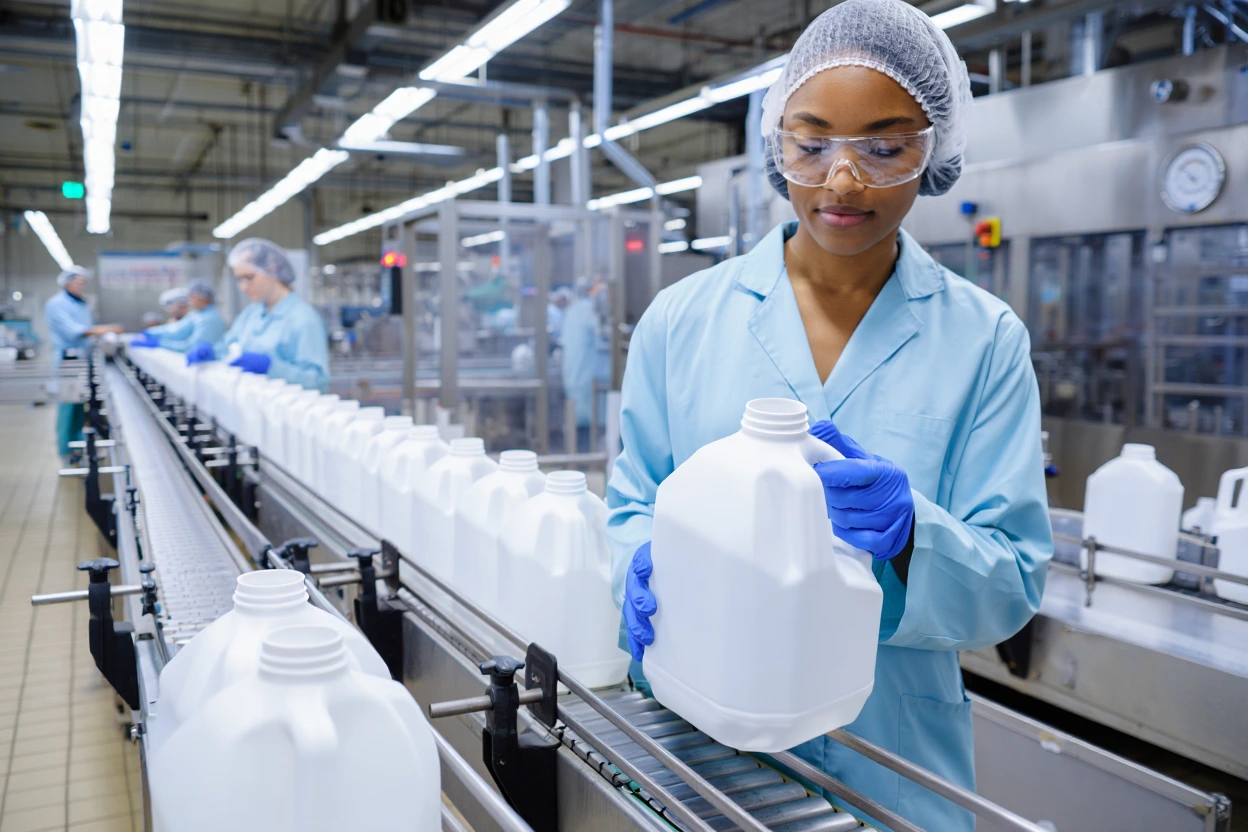
- Packaging and Fill Accuracy: Automated filling lines use gravimetric weight-checking to confirm precise fill volumes across every container format, from trigger spray bottles to 275-gallon IBC totes.
Choosing the Right Degreaser Manufacturing Partner
Technical capability is the threshold criterion. A manufacturer that cannot demonstrate liquid and powder format capability, formulation modification services, and packaging configurations spanning from 5-gallon pails to bulk tankers is not equipped to grow with a degreaser line as it scales across distribution channels.
Beyond equipment, geography carries more weight in bulk chemical logistics than most procurement teams initially account for. A centrally located blending facility with direct freight access to major manufacturing hubs can meaningfully reduce freight costs and lead times for high-volume accounts shipping 55-gallon drums or 275-gallon totes compared to sourcing from either coast. Proximity to the end-use environments a formulation is designed to serve also informs formulation decisions in ways a distant manufacturer cannot easily replicate.
Regulatory Compliance and Safety Standards in Degreaser Manufacturing Services
Chemical manufacturing at the industrial scale operates under layered regulatory oversight, and a manufacturer that treats compliance as a secondary concern creates liability risk for every brand whose product runs through its facility.
OSHA’s Hazard Communication Standard (HazCom 2012, aligned with the Globally Harmonized System) requires that every hazardous chemical produced or handled in a U.S. facility be accompanied by a compliant Safety Data Sheet and GHS-formatted label. For a manufacturer producing toll blended degreasers, this means generating accurate SDS documentation for each formulation, including correct hazard classifications, exposure limits, first-aid measures, and disposal guidance, and confirming that label artwork submitted by a client meets all GHS pictogram, signal word, and precautionary statement requirements before a product ships. Errors in SDS or label content are not administrative inconveniences; they are compliance violations that carry per-incident penalties. Formulations that carry hazmat classifications also need packaging and shipping documentation handled correctly from the start, which is where hazmat chemical packaging support becomes essential.
At the facility level, chemical storage, secondary containment, stormwater management, and wastewater discharge fall under both federal EPA regulations and state environmental standards. Facilities operating near industrial waterways face active oversight of runoff prevention and spill containment protocols, not theoretical review. Brands whose formulations are manufactured at a facility that has already built compliance infrastructure into daily operations avoid treating it as an expensive add-on later.
Frequently Asked Questions
What is the difference between toll blending and contract manufacturing?
Toll blending is a narrower service: the client provides the formulation, and sometimes the raw materials, while the manufacturer executes the blending and packaging. Contract manufacturing covers a broader scope, including custom formulation development, raw material sourcing, QA/QC protocol development, packaging configurations, and outbound logistics. Many brands start with toll blending and expand into full contract manufacturing as their degreaser line grows. See degreaser contract blending for a full breakdown of service structure.
What packaging formats are available for toll blended degreasers?
Standard configurations include 32-ounce trigger spray bottles for janitorial and commercial use, 1-gallon jugs for mid-volume commercial accounts, 5-gallon pails, 55-gallon drums, and 275-gallon IBC totes for high-volume industrial distribution. Container material selection, such as HDPE, polypropylene, or steel, depends on the formulation’s pH, solvent content, and shelf-life requirements.
Can water-based degreasers perform as well as solvent-based ones?
Yes, with the right surfactant architecture. Modern aqueous formulations use non-ionic surfactant blends, specifically alcohol ethoxylates, alkyl polyglucosides, and amine oxides, combined with alkaline builders to emulsify and lift heavy mineral oils, synthetic lubricants, and stamping compounds from metal substrates. The performance gap between aqueous and solvent-based systems has narrowed considerably over the past decade, and for most common industrial soils, a well-formulated water-based degreaser eliminates the flammability risk, VOC liability, and waste disposal complexity of solvent-based alternatives without sacrificing cleaning efficacy.
What is the typical minimum order quantity for degreaser manufacturing services?
Minimum order quantities vary based on formulation complexity, raw material procurement lead times, and packaging line configuration. For liquid blending, minimums typically start at 500 to 1,000 gallons, the threshold at which production and packaging line efficiency justifies the setup cost. Powder blending minimums are governed by dry-blending equipment cycle times and packaging line requirements. A technical team can provide specific guidance once a formulation and packaging configuration are defined.
How long does it take to go from formulation review to first production run?
Timelines depend on formulation complexity and whether raw materials need to be sourced or are already on hand. A straightforward reformulation of an existing degreaser with common ingredients can often move from feasibility review to pilot batch within a few weeks, while a fully custom formulation with specialty surfactants or corrosion inhibitors may take longer to validate. Building in time for pilot batch testing and QA/QC review before committing to a full production run helps avoid costly rework later.
Improving a chemical supply chain requires more than finding a manufacturer with available tank capacity. It requires a partner who understands formulation chemistry well enough to catch compatibility issues before they reach production, who maintains QA/QC protocols rigorous enough to defend batch consistency across every order, and who operates under the regulatory framework that governs industrial chemical manufacturing rather than consumer cosmetics or food supplements. The next step is a formulation feasibility review, where a technical team evaluates a formula, target volumes, and packaging requirements and returns a concrete cost-benefit analysis.
Ready to scale degreaser production? Contact Industrial Technology Corporation today to discuss degreaser manufacturing and packaging requirements with a technical team based in Davenport, Iowa.