Jayme Reid is an SEO specialist at BizIQ who helps manufacturers, service businesses, and B2B companies get found by the buyers searching for them. Jayme manages SEO for more than 40 clients across a wide range of industries, with a focus on content strategy, technical SEO, and structured data. Her writing turns complex industry topics into clear, practical guidance that helps decision makers compare options and make confident choices.
In today’s fast-paced industrial landscape, customization and precision are paramount. Among the many specialized services available, solvent blending services have emerged as a cornerstone for industries requiring tailored chemical solutions. These services combine technical expertise and advanced processes to deliver customized solvent formulations that enhance efficiency, sustainability, and overall operational success.
What Are Solvent Blending Services?
Solvent blending involves combining two or more solvents or chemicals to create a tailored solution with specific properties. This process ensures that businesses across various industries have access to formulations optimized for their unique requirements.
Understanding the Solvent Blending Process
At its core, the solvent blending process is both a science and an art. Here’s how it typically works:
Needs Assessment: A thorough consultation is conducted to understand the client’s specific requirements, including desired chemical properties, performance characteristics, and regulatory compliance.
Material Selection: Based on the client’s needs, appropriate solvents or chemicals are selected. These can range from water-based solvents to volatile organic compounds (VOCs).
Precision Blending: Using advanced equipment, solvents are carefully blended under controlled conditions to achieve the desired formulation. This step often involves strict quality control measures to ensure consistency and accuracy.
Testing and Validation: The blended solution undergoes rigorous testing to verify that it meets specified performance and safety standards. Adjustments may be made to fine-tune the formulation.
Packaging and Delivery: Once approved, the final product is packaged according to the client’s specifications and delivered for use.
Key Components and Materials Used
The materials used in solvent blending vary widely depending on the application. Common components include:
Organic Solvents: Such as acetone, ethanol, and toluene.
Inorganic Solvents: Such as water, ammonia, or acids.
Additives: Such as stabilizers, surfactants, or inhibitors to enhance performance or longevity.
Specialty Chemicals: Customized chemicals designed to meet specific industry needs.
By tailoring these components, solvent blending services can meet the precise demands of any industry, ensuring optimal performance and compliance.
Key Applications of Solvent Blending in Modern Industries
The versatility of solvent blending services makes them invaluable across a wide array of industries. From manufacturing to pharmaceuticals, customized solvent formulations drive innovation and efficiency.
Applications in Manufacturing and Chemical Production
Manufacturing and chemical production rely heavily on solvents for various processes, including:
Coatings and Paints: Solvent blending is essential for creating formulations with specific drying times, viscosity, and durability. Custom blends ensure coatings meet stringent performance standards.
Adhesives and Sealants: Properly blended solvents enhance the strength, flexibility, and longevity of adhesives, crucial for industries like construction and automotive.
Cleaning Solutions: Industrial cleaning often requires solvents capable of removing tough residues without damaging surfaces. Blended solvents provide tailored cleaning power while maintaining safety.
Industrial Lubricants: Solvent blending optimizes lubricant performance by ensuring compatibility with equipment and environmental conditions.
Role in Pharmaceutical and Cosmetics Industries
The pharmaceutical and cosmetics industries demand precision and safety in their formulations, making solvent blending indispensable:
Drug Formulations: In pharmaceuticals, solvent blending enables the creation of carrier solutions that enhance drug stability, bioavailability, and delivery.
Personal Care Products: Cosmetics and personal care products often require unique solvent combinations to achieve desired textures, absorption rates, and skin compatibility.
Regulatory Compliance: Solvent blending ensures formulations adhere to stringent regulatory standards for safety and efficacy in these sensitive industries.
By providing precise, compliant solutions, solvent blending services play a critical role in these high-stakes sectors.
Benefits of Choosing Professional Solvent Blending Services
Partnering with a professional solvent blending provider offers numerous advantages that enhance operational efficiency, reduce costs, and provide customized solutions tailored to unique business needs.
Cost Efficiency and Resource Optimization
One of the primary benefits of solvent blending services is the potential for cost savings and resource optimization:
Reduced Waste: Professional blending minimizes waste by delivering precise quantities of solvents tailored to the client’s needs.
Lower Material Costs: Access to bulk purchasing and optimized formulations can significantly reduce material costs.
Improved Efficiency: Custom blends eliminate the need for trial-and-error, streamlining processes and reducing downtime.
By leveraging expert services, businesses can achieve greater cost efficiency while maintaining high-quality standards.
Customization and Scalability for Unique Needs
Every industry and application is unique, requiring tailored solutions that address specific challenges. Solvent blending services excel in providing:
Custom Formulations: From specific viscosity levels to precise drying times, formulations are created to meet exact performance criteria.
Scalability: Professional providers offer scalable solutions, from small test batches to full-scale production runs, ensuring flexibility as business needs evolve.
Regulatory Compliance: Expert knowledge of industry regulations ensures that all blends meet required standards, reducing the risk of non-compliance.
Customization and scalability empower businesses to remain competitive and adaptable in a rapidly changing industrial landscape.
Partner with Industrial Technology Corporation for Solvent Blending Services
The importance of solvent blending services in modern industries cannot be overstated. From enhancing efficiency and sustainability to enabling innovation and compliance, these services provide indispensable value to businesses across sectors.
Whether you need custom toll blending services, private label opportunities, or quality chemical formulations for your business, Industrial Technology Corporation is here to meet your needs. Simply contact us today to inquire about our services, request a quote, or discuss your specific requirements. We look forward to working with you to develop innovative solutions that drive your business’s success.
In the world of chemical manufacturing, precision is not just a requirement—it’s the cornerstone of successful production. Multi-component blending, the intricate process of combining multiple chemical substances into a homogeneous mixture, is an essential technique in industries ranging from pharmaceuticals to agriculture.
What Is Multi-Component Blending?
Multi-component blending refers to the process of combining two or more chemical components to produce a finished product or intermediate material with specific properties. Depending on the formulation, the components may include liquids, solids, or gases. The goal is to achieve uniformity and maintain the desired chemical and physical characteristics, ensuring the end product meets quality standards and functional requirements.
Industries utilizing multi-component blending span diverse sectors, such as:
Pharmaceuticals for drug formulations
Agriculture for fertilizers and pesticides
Automotive for lubricants and fuels
Food and Beverage for flavorings and additives
Industrial Chemicals for coatings, adhesives, and sealants
The Core Principles of Multi-Component Blending
Achieving precision in multi-component blending involves adhering to several scientific and engineering principles:
Proportional Accuracy
To maintain the integrity of the final formulation, each component must be measured with exacting precision, often to milligram or microliter levels. Small deviations can result in defective products or unintended reactions.
Homogeneity
Homogeneity ensures that every portion of the mixture contains the same ratio of components. Achieving this requires advanced mixing technologies and expertise in material properties.
Stability
Stability ensures the blended components do not separate or degrade over time. Stabilizing agents, temperature control, and careful handling are often necessary to maintain product consistency.
Reactivity
Some chemical components interact during blending, requiring precise control over reaction conditions such as temperature, pressure, and mixing speed to avoid undesired outcomes.
Technologies Used in Multi-Component Blending
Advances in technology have significantly enhanced the efficiency and precision of multi-component blending. Here are some of the key tools and methodologies employed:
Mixing Equipment
From high-shear mixers to ribbon blenders, the choice of equipment depends on the nature of the materials and the desired product characteristics. For example:
Ribbon Blenders are ideal for dry powders.
High-Shear Mixers handle viscous liquids and emulsions.
Static Mixers are used for continuous blending of fluids.
Automation and Control Systems
Modern blending facilities often incorporate automated systems equipped with sensors and software for real-time monitoring. Automation ensures consistent proportions, reduces human error, and provides traceable records for quality assurance.
Analytical Testing
Technologies such as spectroscopy, chromatography, and particle size analysis verify the blend’s composition and homogeneity. These tests ensure compliance with regulatory and industry standards.
Challenges in Multi-Component Blending
Despite technological advancements, multi-component blending presents several challenges that demand technical expertise and innovative solutions:
Complex Formulations
Some formulations involve dozens of components with varying physical and chemical properties. Managing these complexities requires in-depth knowledge of material science and chemical interactions.
Contamination Control
Cross-contamination can compromise the integrity of a blend, particularly in sensitive industries such as pharmaceuticals and food production. Strict cleaning protocols and specialized equipment designs mitigate this risk.
Environmental Factors
Temperature, humidity, and air quality can affect blending processes. For instance, hygroscopic materials may absorb moisture from the air, altering the final product.
Regulatory Compliance
Blended products must meet stringent industry and governmental regulations, which vary depending on the application. Compliance often involves detailed documentation and validation processes.
Case Studies: Applications of Multi-Component Blending
Pharmaceutical Formulations
In pharmaceutical manufacturing, multi-component blending is critical for producing drugs with precise dosages. Blends must achieve exact particle size distributions and maintain chemical stability, especially for controlled-release medications.
Agricultural Products
Fertilizers and pesticides rely on multi-component blending to combine active ingredients with carriers or stabilizers. Uniform distribution of active compounds ensures effectiveness and minimizes waste.
Coatings and Adhesives
Paints, coatings, and adhesives require multi-component blending to create formulations with specific viscosity, drying times, and durability. The inclusion of stabilizers and dispersants is essential for long-term performance.
Best Practices for Multi-Component Blending
Pre-Formulation Studies
Conducting pre-formulation studies helps identify potential issues, such as incompatibilities between components or the need for specific stabilizers.
Pilot Batches
Producing small pilot batches allows manufacturers to test and refine the blending process before scaling up to full production.
Quality Control
Regular testing during and after blending ensures the product meets specifications. Inline monitoring systems can provide real-time data, enabling immediate adjustments.
Custom Solutions
Partnering with a toll blending provider like Industrial Technology Corporation enables businesses to access custom solutions tailored to their unique needs.
Environmental and Economic Considerations
Sustainability and cost-effectiveness are increasingly important in multi-component blending. Strategies to address these considerations include:
Optimizing Processes to reduce energy and material waste.
Recycling Solvents and By-Products to minimize environmental impact.
Sourcing Sustainable Materials for greener formulations.
Why Partner with a Toll Blending Expert?
Outsourcing multi-component blending to a toll blending expert provides numerous advantages, including access to specialized equipment, technical expertise, and scalable production capabilities. Toll blending partners also handle regulatory compliance, freeing businesses to focus on innovation and market expansion.
Contact Us Today
Whether you’re developing a new product or optimizing an existing formulation, multi-component blending requires precision, expertise, and advanced technology. At Industrial Technology Corporation, we specialize in custom toll blending services, private label opportunities, and high-quality chemical formulations tailored to meet your needs.
Contact us today to request a quote, discuss your specific requirements, or explore how our innovative solutions can drive success for your business. Let us be your partner in precision blending!
In industrial processes, emulsion blending stands out as a crucial technique for creating stable mixtures of immiscible liquids, such as oil and water, often combined with powders to form advanced formulations. Industries ranging from pharmaceuticals to cosmetics and from food production to paints and coatings rely heavily on this technology to develop products that perform efficiently and consistently.
What Is Emulsion Blending?
At its core, emulsion blending involves combining two immiscible liquids, typically oil and water, to create a stable emulsion. This process often requires the addition of emulsifiers, which reduce surface tension and allow the liquids to coexist in a uniform state. When powders are introduced into this system, the complexity increases, necessitating precise techniques and equipment to ensure homogeneity and stability.
The versatility of emulsion blending makes it essential for producing products such as:
Personal care items like lotions and creams.
Industrial coatings and paints.
Nutritional supplements.
Pharmaceutical suspensions.
Food products like dressings and beverages.
Key Advancements in Emulsion Blending Technology
High-Shear Mixing Equipment
One of the most significant advancements in emulsion blending is the use of high-shear mixers. These machines operate at high speeds to create intense mechanical and hydraulic forces, which break down particles and droplets to achieve smaller sizes and a more uniform distribution. High-shear mixers are particularly effective in liquid-powder combinations, as they prevent clumping and ensure powders are evenly dispersed within the liquid medium.
Benefits:
Enhanced stability of the emulsion.
Finer particle sizes, leading to improved product texture.
Reduction in production time.
Ultrasound-Assisted Blending
Ultrasound technology is increasingly being used in emulsion blending to achieve micro- and nano-scale emulsions. This technique involves applying ultrasonic waves to generate cavitation bubbles in the liquid, which collapse and create intense localized energy. This energy is effective at mixing powders into liquids, breaking apart agglomerates, and achieving a stable emulsion.
Cosmetics with smooth textures and improved absorption rates.
Food products with extended shelf life and improved consistency.
Continuous Emulsion Blending Systems
Batch blending has been a standard practice for decades, but continuous blending systems are now gaining traction due to their efficiency. These systems allow for the real-time mixing of liquids and powders, reducing production downtime and ensuring consistent quality.
Advantages:
Scalability for large production runs.
Reduced waste and energy consumption.
Enhanced process control for maintaining product specifications.
Advanced Emulsifiers and Stabilizers
Modern formulations increasingly depend on specialized emulsifiers and stabilizers to enhance the performance and stability of emulsions. These additives are often derived from natural or synthetic sources and are tailored for specific applications.
Example: Phospholipids in food emulsions improve both texture and nutritional value, while silicone-based stabilizers in industrial applications provide enhanced durability and weather resistance.
Impact: These advancements have opened doors for more sustainable and eco-friendly products.
Overcoming Challenges in Liquid-Powder Emulsion Blending
While emulsion blending has seen remarkable advancements, challenges remain, especially in the incorporation of powders. Here’s how modern technology addresses some common issues:
Powder Agglomeration
Powders often clump together when added to liquids, resulting in uneven dispersion. To combat this, industries utilize advanced pre-wetting techniques and vacuum induction systems that introduce powders into the liquid without allowing air to interfere.
Temperature Sensitivity
Some emulsions are highly sensitive to temperature fluctuations, which can lead to phase separation or degradation of active ingredients. Modern blending equipment incorporates precise temperature control systems to maintain ideal conditions throughout the process.
Foaming
Excessive foaming during blending can disrupt the uniformity of the emulsion. Anti-foaming agents and specialized low-shear mixers are now commonly employed to minimize this issue.
Applications of Liquid-Powder Emulsion Blending in Industries
Pharmaceuticals
In the pharmaceutical industry, emulsion blending ensures the uniform distribution of active ingredients, which is critical for dosage accuracy. Innovations like nanoemulsions are being utilized to improve drug delivery systems, enhancing bioavailability and efficacy.
Food and Beverage
Liquid-powder emulsions are essential for creating products like salad dressings, beverages, and nutritional supplements. Advances in this field have allowed manufacturers to develop shelf-stable formulations with reduced preservatives while maintaining taste and texture.
Cosmetics and Personal Care
From moisturizers to sunscreens, the cosmetic industry depends on emulsion blending to create products with smooth, appealing textures and consistent performance. Techniques like high-pressure homogenization have become standard for achieving superior quality.
Paints and Coatings
In industrial applications, emulsion blending technology is used to produce high-performance coatings that offer durability and resistance to environmental factors. The incorporation of powders like pigments and fillers into emulsions ensures consistent coloration and improved protective qualities.
Future Trends in Emulsion Blending
Sustainability and Green Chemistry
As industries prioritize eco-friendly practices, the development of biodegradable emulsifiers and energy-efficient blending equipment is gaining momentum.
Automation and AI Integration
Automated blending systems with AI capabilities are becoming more common. These systems allow for real-time adjustments to formulations based on data analysis, leading to greater efficiency and reduced human error.
Customized Emulsions
The demand for tailored solutions is driving innovation in creating emulsions that meet specific customer requirements, such as unique textures, stability profiles, or performance characteristics.
Why Choose Industrial Technology Corporation for Emulsion Blending?
With decades of experience in custom toll blending, Industrial Technology Corporation is at the forefront of providing innovative solutions for industries requiring emulsion blending. Whether you’re developing a new product or optimizing an existing formulation, Industrial Technology Corporation offers:
A wide variety of blending equipment available.
Expertise in handling liquid-powder combinations.
Customized formulations tailored to your unique needs.
Let Industrial Technology Corporation Help Drive Your Success
Advancements in emulsion blending technology continue to transform industries, enabling the development of high-quality, stable, and efficient products. From high-shear mixers to sustainable practices, the possibilities are endless for those who leverage these innovations.
Whether you need custom toll blending services, private label opportunities, or quality chemical formulations for your business, Industrial Technology Corporation is here to meet your needs. Simply contact us today to inquire about our services, request a quote, or discuss your specific requirements. We look forward to working with you to develop innovative solutions that drive your business’s success.
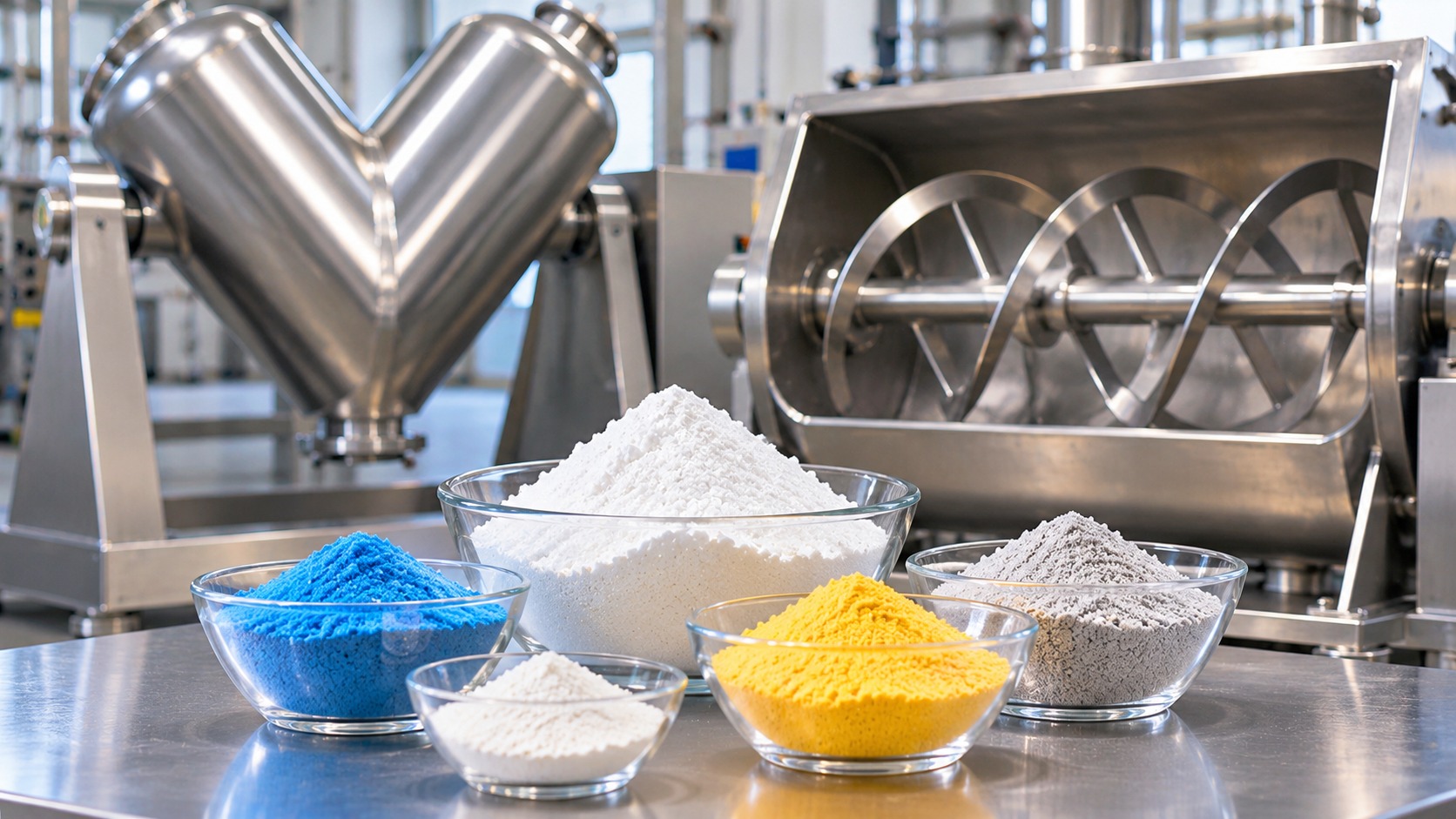
Powder blending techniques decide whether a dry formula comes out the same in every bag or whether fines, heavy particles, and active ingredients drift to different parts of the batch. The right method depends on particle size, density, and how freely the powders flow, and getting it right protects product performance, consistency, and customer trust.
What Are the Best Powder Blending Techniques?
The best powder blending technique depends on the powders: tumble blending suits free-flowing, fragile materials, ribbon or paddle blending handles dense and mixed-property powders, and high-shear blending breaks up clumps in cohesive powders.
Free-flowing powders of similar size: tumble blending in a V-blender or double-cone blender.
Dense or varied powders in larger batches: ribbon blending.
Fragile or shear-sensitive solids: paddle blending.
Cohesive powders that clump: high-shear or intensive mixing, often after sieving.
Large, steady volumes: continuous blending.
Tiny amounts of a potent ingredient: geometric dilution before the main blend.
Core Powder Blending Techniques: Convection, Diffusion, and Shear
Every powder mixer works through three mechanisms, and each blender favors a different combination of them.
Mechanism
What Happens
Strength
Limitation
Convection
Groups of particles move together through the blender
Fast, large-scale mixing
Weak at the individual-particle level
Diffusion
Individual particles move into gaps as the bed tumbles or is disturbed
Fine-scale uniformity
Slower than convection
Shear
Layers of powder slide across each other and break up agglomerates
Disperses clumps and cohesive powders
Can damage fragile particles and add heat
Most real blends rely on all three, in proportions set by the equipment and the powder. Choosing a blender is largely choosing which mechanism should dominate.
Powder Blending Techniques for Dissimilar Powders
Dissimilar powders, meaning those that differ in size, density, or quantity, are the hardest to blend because they start separating as soon as they move. These techniques reduce the gap:
Narrow the size range. Mill coarse ingredients or sieve out oversize material before blending.
Use geometric dilution. Blend the minor ingredient with an equal amount of the major ingredient, then keep doubling the portion until everything is combined.
Premix small additions. Disperse trace ingredients into a carrier before they enter the main batch.
Break up agglomerates. Pass cohesive ingredients through a sieve before charging the blender.
Fix the addition order. Add fines to a bed of coarse material in a consistent sequence, and record it.
Powder Blending Equipment: Choosing the Right Blender
Match the blender to the material, the batch size, and the level of uniformity the product needs.
Blender
Best For
Watch Out For
V-blender or double-cone
Free-flowing, fragile powders and gentle mixing
Low shear, so cohesive powders may stay clumped
Ribbon blender
Larger batches and powders with varied properties; combines convection and shear
Dead zones near the ends if the fill level or design is wrong
Paddle blender
Fragile or shear-sensitive solids
Longer cycle times than ribbon blending for some powders
High-shear or intensive mixer
Cohesive powders and agglomerates
Heat, static, and particle damage if overrun
Three-dimensional lab mixer
Small batches, trials, and formula development
Limited batch size
Continuous blender
High, steady throughput
Needs consistent, accurate feeding of every ingredient
V-Blender vs Ribbon Blender: Which Is Better?
A V-blender is better for gentle mixing of free-flowing powders, and a ribbon blender is better for larger batches and powders that clump or differ in density.
Factor
V-Blender
Ribbon Blender
Main mechanism
Tumbling (diffusion and convection)
Convection plus shear
Shear
Low
Moderate
Cohesive powders
Struggles
Handles better
Fragile particles
Gentle
Less gentle
Batch size
Small to medium
Medium to very large
Equipment is only half of the result. Production runs for dry formulas also depend on validated blend times, controlled addition order, and testing, which is why the same blender can give different results in different hands.
Key Factors That Decide Powder Blend Quality
Four properties of the powders themselves control how well they blend: particle size, density, flow behavior, and moisture.
Particle Size and Density
Differences in particle size are the main driver of segregation, and density differences matter most when sizes are similar. Powders with a narrow size distribution blend faster and hold their uniformity longer. A wide spread invites fines to sift downward while coarse particles rise.
Flowability and Cohesion
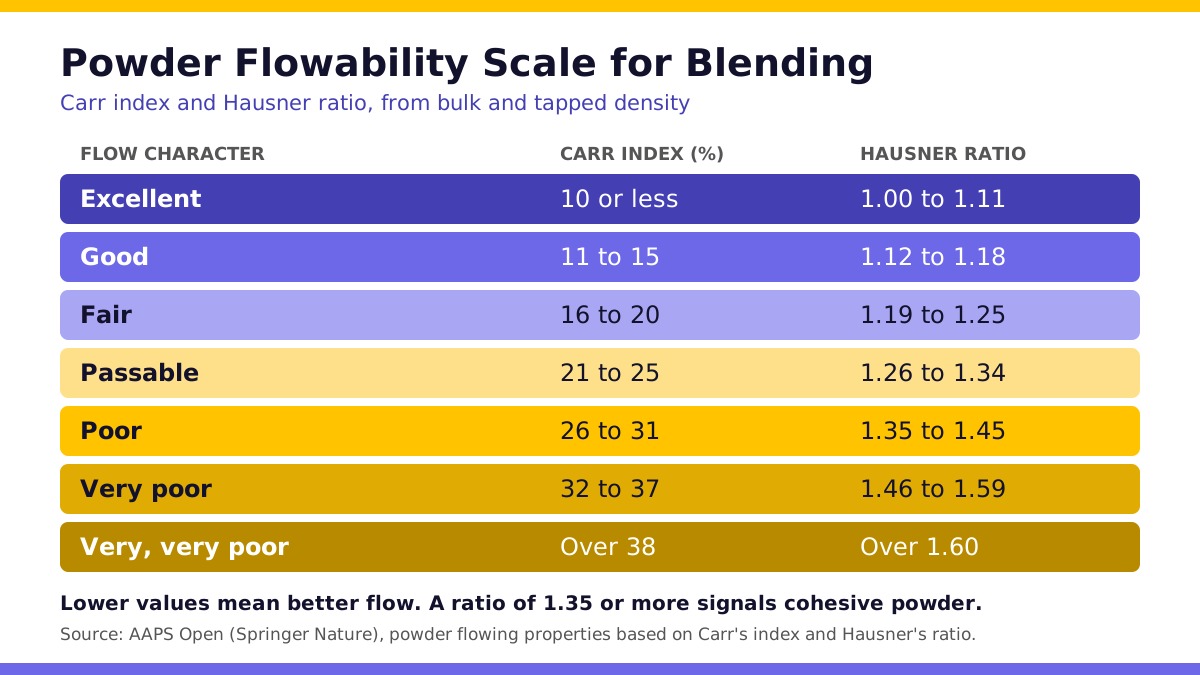
Flowability is measured with the Carr index and Hausner ratio, both calculated from a powder’s bulk and tapped density. A Hausner ratio of 1.25 or lower is rated fair or better, while 1.35 or higher signals poor, cohesive flow that tends to clump and resist mixing.
Free-flowing powders are easy to move but, as the next section explains, also the easiest to separate. Cohesive powders resist segregation but need shear or pre-sieving to break up lumps.
Moisture, Static, and Environment
Humidity makes powders sticky and prone to caking, while dry conditions and fast mixing build static charge that pulls fine particles onto equipment surfaces. Controlling humidity, drying ingredients, and keeping blend speed within a tested range keep the batch consistent. Fine powders can also be combustible, so dust control belongs in every blending plan.
How to Optimize Powder Blending Parameters
Four settings need to be validated for each formula: blend time, speed, fill level, and ingredient order.
Parameter
Too Little
Too Much
Blend time
Incomplete mixing and pockets of unmixed material
Particle breakage, heat, and renewed segregation
Blender speed
Clumps survive and mixing is slow
Heat, static, and damage to fragile particles
Fill level
Too little bed movement for good mixing
Poor particle movement and dead zones
Addition order
Fines sit on the surface and clump
Not applicable: consistency matters more than amount
Optimal values are found by testing. Take samples at increasing blend times, measure uniformity, and set the time where results stop improving. Follow the blender manufacturer’s working-volume range for fill level.
Why Powder Blends Separate After Mixing
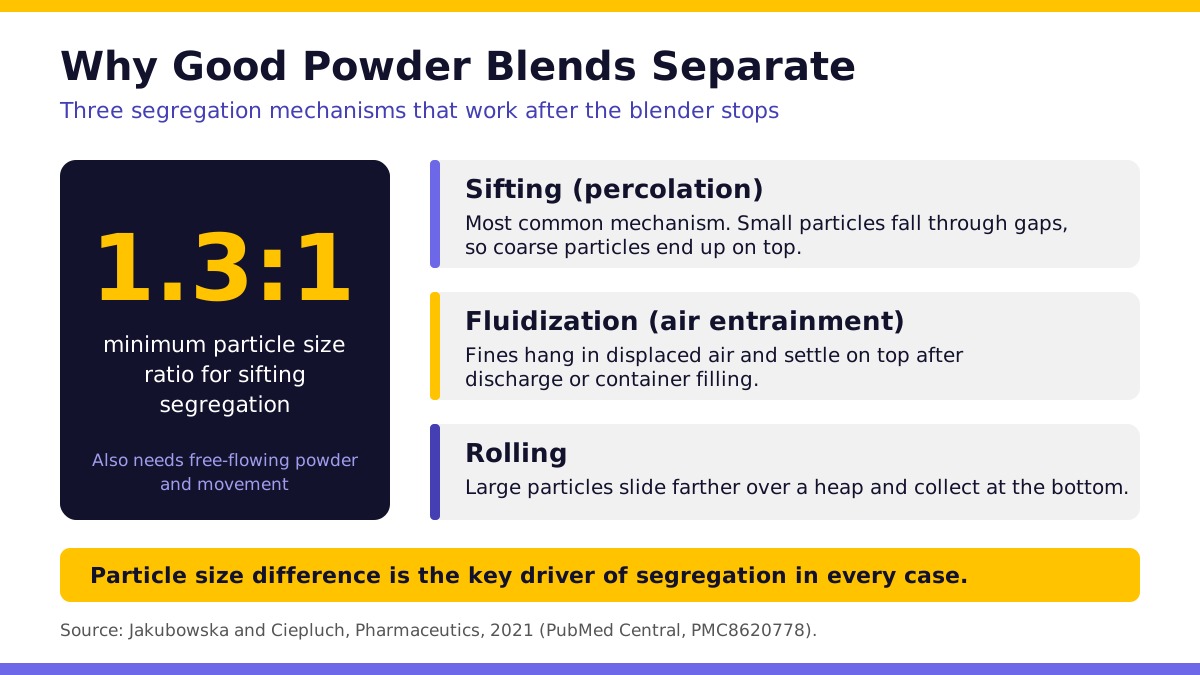
A well-mixed powder can separate during storage, transfer, and filling, and a peer-reviewed review in Pharmaceutics identifies sifting, fluidization, and rolling as the main segregation mechanisms.
Mechanism
What Happens
Where It Shows Up
Sifting (percolation)
Small particles fall through gaps between larger ones, so coarse particles end up on top
Pouring, vibration, hopper filling
Fluidization (air entrainment)
Fines hang in displaced air and settle on top
Discharge, long drops, container filling
Rolling
Large particles slide farther over a heap and collect at the bottom and outer edges
Heaps and chutes
Sifting is the most common mechanism, and it needs a particle size ratio of at least 1.3 to 1, free-flowing material, and movement. That combination is common in dry blends, which is why uniformity is lost after the blender stops.
Prevent segregation by narrowing particle size differences and limiting what happens to the powder after it is blended.
Minimize drop heights. Long free falls give air more time to pull fines away.
Use wide chutes and vented transfer. Wider pipes and a path for displaced air reduce fluidization.
Use mass-flow hoppers. Steep, smooth hoppers discharge the whole mass together instead of in a central funnel.
Cut the number of transfers. Every move between vessels is a chance to separate.
Plan the finish. Fill and close containers promptly, and coordinate packaging after blending so the blend is not held in motion.
Segregation susceptibility can be measured before production with the ASTM D6940 sifting test and the ASTM D6941 fluidization test.
Batch vs Continuous Blending
Continuous blending can reduce segregation because particles move through a restricted space for a controlled time. In one comparison covered in the same review, a continuous mixer kept uniformity for blends that segregated in a batch V-blender. Batch blending remains the practical choice for varied formulas, short runs, and frequent product changes, which is where most toll work sits.
How to Test That a Powder Blend Is Uniform
Verify uniformity by sampling several locations and comparing results against a specification set for the formula.
Multi-point sampling: take samples from different depths and positions, not only the top of the batch.
Sampling technique: the same review lists sampling and analytical errors among common causes of failed uniformity results, so the method matters as much as the lab.
Chemical assay: measure the concentration of the critical ingredient in each sample.
Spectroscopy: near-infrared and Raman methods can check dispersion without disturbing the blend.
Particle size and imaging: confirm size distribution and look for agglomerates.
Records: tie every result to a batch number.
Powder Blending Applications by Industry
Dry blends show up in many chemical products, and each has its own uniformity risk.
Industrial Technology Corporation is a family-owned toll blender with more than 40 years of experience, serving manufacturers that need consistent dry and liquid products. Its liquid, powder, and emulsion capabilities let a customer move a formula from small trials to production without changing partners.
Get a Uniform Powder Blend Without the Trial and Error
Share your formula, ingredient list, target specifications, and volumes with Industrial Technology Corporation, and you will get a clear plan for how the blend should be mixed, tested, and packaged. Request a custom blending quote to get started.
There is no universal time. Blend time is set by testing: sample the batch at several points after increasing times and stop when uniformity stops improving. Blending too long can break particles or let free-flowing components separate again.
What is the best blender for powders?
No single blender is best for every powder. V-blenders suit free-flowing, fragile powders, ribbon blenders suit larger batches and mixed-property powders, and high-shear mixers suit cohesive powders that clump.
How do you blend powders of different particle sizes?
Narrow the size gap by milling or sieving, premix small ingredients into a carrier or use geometric dilution, and limit handling after blending. Particle size differences are the main driver of segregation.
What causes powder segregation?
Differences in particle size are the main cause, acting through sifting, air entrainment, and rolling. Density, shape, and free-flowing behavior add to the risk, especially during transfer, discharge, and filling.
What is a good Hausner ratio for blending?
A Hausner ratio of 1.25 or lower is rated fair or better on the standard flowability scale. Ratios of 1.35 and above indicate poor, cohesive flow that may need sieving, flow aids, or high-shear mixing.
Can you over-mix a powder?
Yes. Mixing past the optimum can break fragile particles, generate heat or static, and let free-flowing components start to separate again.
What is geometric dilution?
Geometric dilution blends a small ingredient with an equal amount of a larger ingredient, then keeps adding more of the larger ingredient in doubling portions until all of it is combined. It spreads a potent minor ingredient evenly.
When does outsourcing powder blending make sense?
Outsourcing makes sense when you lack the right blenders, quality control, or capacity, or when a formula needs blending, testing, and packaging as one workflow. A toll blender runs the formula at production scale without a capital investment in equipment.
When it comes to creating high-quality car care products, one key component is achieving the right blend of soaps and waxes. Whether used for hand washes, automated tunnel washes, or detailing services, car wash soaps and waxes require careful formulation to ensure they deliver both cleaning power and protection. This is especially true in today’s market, where customers seek not only cleanliness but a showroom-quality finish.
Understanding the Chemistry of Car Wash Soaps
Car wash soaps are more than just simple detergents. They’re crafted blends of surfactants, emulsifiers, and other agents designed to lift dirt, oil, and grime from a car’s surface without harming the paint or finish. The composition of these soaps affects their performance, including their foaming ability, rinsability, and compatibility with waxes and sealants.
Surfactants and Their Role
Surfactants are one of the primary components in car wash soaps. These molecules are specially designed to lower the surface tension between water and contaminants, allowing dirt and oils to be lifted off surfaces more effectively. Different types of surfactants can be used to create various levels of cleaning power and foam. For example:
Anionic surfactants provide a rich lather and are excellent at breaking down oils and dirt but may be harsher on certain finishes.
Non-ionic surfactants are gentler and work well in combination with other chemicals to stabilize and soften the cleaning process.
Amphoteric surfactants are versatile and can adapt to varying pH levels, making them ideal for formulations that require compatibility with waxes and conditioners.
Balancing pH Levels
A car wash soap’s pH level is critical for ensuring it cleans effectively without damaging the vehicle’s surface. High-alkaline soaps are effective at removing tough grime but may be too harsh for some finishes. Neutral or slightly acidic soaps are gentler and better suited for routine washes. Finding the right pH balance is crucial for manufacturers to offer a versatile soap that is safe for all paint types and finishes.
The Art and Science of Blending Waxes
Waxes add a protective, glossy layer to the car’s surface, enhancing shine and helping repel dirt, water, and UV rays. The blending of waxes for car care products requires a careful combination of natural and synthetic ingredients, emulsifiers, and stabilizers to ensure that the wax adheres well to the surface and lasts over time.
Types of Waxes in Car Care Products
The most common waxes used in car care products include:
Carnauba wax, derived from the leaves of the carnauba palm, is highly prized for its gloss and hydrophobic properties. It’s typically blended with other ingredients to enhance its spreadability and durability.
Synthetic polymers provide excellent durability and are often used in longer-lasting car waxes. They can be blended to produce a finish that rivals natural waxes while offering easier application and increased resilience.
Beeswax and other natural waxes add smoothness and improve texture in many formulations, although they’re generally used as secondary components to enhance the primary wax.
Liquid Blending for Wax Consistency and Performance
The blending process for waxes requires a high degree of precision to ensure consistency. Liquid blending equipment must be capable of evenly mixing ingredients at controlled temperatures to achieve a uniform product. Factors such as mixing speed, shear rate, and the order of ingredient addition can impact the performance of the final product. Careful blending ensures that the wax provides an even coat, bonds well with the paint, and enhances the car’s appearance.
Combining Soaps and Waxes for Optimal Results
Creating a car wash product that both cleans and protects requires the skillful blending of soaps and waxes. Car wash formulations that combine these two elements must achieve a delicate balance where the soap cleans effectively without stripping away the wax.
Challenges in Blending Soaps and Waxes Together
The blending of soaps and waxes presents a few challenges:
Compatibility: The pH of the soap and the wax’s stability must be compatible to avoid separation or degradation over time.
Cleaning vs. Protecting: While soaps are designed to lift and remove contaminants, they shouldn’t be so strong that they remove protective wax layers with each wash.
Rinseability: Products need to rinse cleanly without leaving residue, which can be challenging when waxes are involved, as wax residues can sometimes cause streaking.
Strategies for Effective Soap and Wax Blends
To overcome these challenges, formulators often employ techniques such as:
Layered Blends: Use surfactants that offer mild cleaning power along with polymers and waxes that deposit a thin layer of protection.
Time-Released Waxes: These advanced wax formulations slowly release over multiple washes, providing a gradual build-up of protection with regular use.
Emulsifiers: Emulsifiers are crucial in creating stable, homogeneous blends of soaps and waxes. They help combine oil- and water-based ingredients to produce a uniform, easily applied product.
The Role of Liquid Blending in Car Wash Formulation
Precision liquid blending is essential in the production of car wash soaps and waxes. With sophisticated equipment and highly controlled processes, manufacturers can ensure uniform consistency, texture, and performance in every batch.
Key Equipment and Techniques in Liquid Blending
The following equipment and techniques are vital for successful liquid blending:
High-shear mixers: Used to break down wax particles and incorporate them evenly into the solution. High-shear mixing is crucial when dealing with viscous ingredients or emulsions.
Inline homogenizers: These systems are used to ensure that all ingredients are mixed to a fine particle size, resulting in a stable emulsion.
Batch mixing tanks: Equipped with variable speed control, these allow for the blending of large quantities of product without compromising consistency.
Temperature control: Heat is often applied during blending to help dissolve or soften certain waxes and surfactants, making them easier to mix uniformly.
Quality Control in Blending
In car wash product formulation, consistency and performance are paramount. Each batch must undergo rigorous quality checks to ensure it meets the desired specifications. Common tests include:
Viscosity tests to ensure the product flows evenly during application.
Stability tests to determine whether the soap and wax separate over time.
Foam tests to measure the foaming capacity of soaps.
Gloss and water-repellency tests to assess the effectiveness of waxes.
Innovations in Car Wash Soap and Wax Blends
With advancements in chemical engineering and liquid blending technology, today’s car wash products are more effective and longer lasting than ever. Innovations in blending processes and ingredient formulations allow manufacturers to develop products with enhanced cleaning, protection, and shine.
Eco-Friendly Formulations
As consumers become more environmentally conscious, car wash product manufacturers are creating eco-friendly formulations that are biodegradable and free from harsh chemicals. Advanced liquid blending enables formulators to incorporate eco-friendly surfactants, natural waxes, and sustainable ingredients without compromising performance.
Nano-Ceramic Waxes
One of the latest trends in car wax is the use of nano-ceramic technology. These waxes incorporate nano-sized particles that bond at a molecular level to the car’s surface, creating a highly durable and glossy finish. Nano-ceramic waxes require advanced liquid blending techniques to ensure an even distribution of particles and proper adhesion.
Multi-Function Blends
Today’s car wash products are evolving to offer multiple benefits in a single application. From soap-wax combinations that clean, shine, and protect to UV-blocking ingredients that prevent paint fading, multi-function formulations provide added value to customers. Such complex formulations rely on precision liquid blending to combine diverse ingredients seamlessly.
Custom Blending Solutions for the Car Wash Industry
For businesses in the car wash industry, custom formulations provide an edge in a competitive market. Custom toll blending services allow brands to develop proprietary blends tailored to specific customer needs, environmental conditions, or equipment.
Private Label Opportunities
Many companies in the car wash industry leverage private labeling to offer products under their brand names. Toll blending companies can provide turnkey private label solutions, from formulation to packaging, enabling car wash businesses to develop their own line of soaps and waxes without the need for in-house blending facilities.
Advantages of Working with a Liquid Blending Specialist
Partnering with an experienced toll blending provider allows car wash product companies to scale production, maintain consistency, and adhere to quality standards. The benefits of working with a specialist in liquid blending include:
Access to state-of-the-art equipment: Professional blending facilities have access to advanced mixers, homogenizers, and heating systems, which are essential for producing high-quality car care products.
Expertise in chemical formulation: Skilled chemists and engineers understand how to balance soaps, waxes, and other additives to create a product that meets specific performance criteria.
Quality assurance protocols: Toll blending providers maintain strict quality control processes, ensuring every batch meets high standards for consistency, stability, and performance.
Partner with Industrial Technology Corporation for Your Liquid Blending Needs
The science and precision behind car wash soaps and waxes highlight the importance of quality liquid blending in producing top-tier products for the automotive industry. From selecting the right surfactants and waxes to implementing state-of-the-art blending techniques, creating high-performing car wash products requires expertise and dedication.
At Industrial Technology Corporation, we specialize in custom toll blending services, private label opportunities, and high-quality chemical formulations to meet your business’s unique needs. Whether you’re looking to develop a new car wash product, enhance an existing formula, or create a custom solution, our team is here to help.
Contact us today to discuss your specific requirements, request a quote, or learn more about how our blending services can elevate your product line. We look forward to working with you to develop innovative solutions that drive your business’s success.