In today’s competitive manufacturing landscape, emulsion toll blending services are a critical tool for companies producing products that rely on stable emulsions—such as cosmetics, agrochemical sprays, paints, lubricants, and specialty coatings. These services combine industrial-scale blending capabilities with technical expertise in emulsion science, ensuring that emulsified systems achieve optimal stability, uniformity, and performance. By leveraging advanced shear control and phase stabilization techniques, emulsion toll blending providers can enhance product quality, reduce defects, and improve consistency from batch to batch.
The science behind emulsions is deceptively complex. An emulsion may appear uniform to the naked eye, but at the microscopic level, droplet size distribution, interfacial tension, and viscosity all play a role in determining how well the product will perform over time. Toll blenders with specialized emulsion capabilities bridge the gap between laboratory formulation and reliable commercial-scale production—ensuring every container leaving the facility meets stringent quality standards.
Below, we’ll explore the specific ways emulsion toll blending services improve product quality, with an emphasis on stability, shear control, and rigorous quality testing.
Stability Advantages of Emulsion Toll Blending Services
For any emulsified product, stability is paramount. Without proper blending and stabilization, emulsions are prone to phase separation, creaming, sedimentation, or flocculation—issues that can drastically reduce shelf life and product effectiveness.
A professional emulsion toll blending service provides:
Precision in ingredient dispersion: High-performance mixing equipment ensures that oil and water phases are uniformly combined and stabilized.
Controlled addition of emulsifiers and stabilizers: The selection and dosing of surfactants, polymers, or thickeners are timed and proportioned to ensure optimal interfacial film formation.
Environmental controls: Factors such as temperature and humidity can influence emulsion stability. Toll blending facilities often feature environmental management systems to maintain ideal blending conditions.
Phase Separation Prevention in Emulsion Toll Blending Services
One of the core stability benefits is preventing phase separation. This occurs when the dispersed phase (e.g., oil droplets) coalesces or rises/sinks due to density differences. Toll blending services combat this by:
Applying precise shear rates during homogenization to reduce droplet size below the threshold where gravity-driven separation becomes significant.
Incorporating stabilizing agents that form protective layers around droplets, reducing the likelihood of coalescence.
Fine-tuning viscosity of the continuous phase to slow droplet movement.
For industries like cosmetics, where the aesthetic and tactile properties of lotions or creams are crucial, phase separation prevention is a direct contributor to consumer satisfaction and brand reliability.
Shear Control Techniques in Emulsion Toll Blending Services
The application of shear forces is central to emulsion formation and stability. Too little shear, and droplets remain too large, leading to poor stability and performance. Too much shear, and sensitive components—such as fragile encapsulations or bioactives—can be damaged.
Professional toll blending facilities employ customizable shear profiles, adapting the blending process to the needs of the formulation.
High-Shear vs. Low-Shear Methods in Emulsion Toll Blending Services
Two primary categories of shear application are used in emulsion production:
Purpose: Maintain emulsions without over-processing; often used in post-emulsification stages.
Advantages: Preserves fragile components; reduces risk of over-aeration.
Considerations: Not suitable for initial emulsification of high-viscosity or complex systems.
Toll blenders have the expertise to sequence these shear methods—starting with high shear for droplet creation, then transitioning to low shear for blending in sensitive additives without destabilizing the emulsion.
Quality Testing in Emulsion Toll Blending Services
Consistent quality in emulsified systems doesn’t happen by accident—it is the result of methodical quality control procedures integrated into every stage of production.
Typical testing protocols include:
Visual inspection for signs of separation, color variation, or particulate matter.
Microscopic analysis to assess droplet size distribution.
Viscosity measurement to confirm rheological properties meet specifications.
Accelerated stability testing to simulate long-term storage conditions.
Viscosity and Droplet Size Analysis
Two of the most critical parameters for emulsion quality control are viscosity and droplet size.
Viscosity Testing
Determines the flow characteristics of the emulsion.
Ensures the product applies or sprays as intended.
Helps maintain batch-to-batch uniformity.
Droplet Size Analysis
Performed using laser diffraction, dynamic light scattering, or microscopy.
Smaller, uniform droplets enhance stability by reducing the potential for coalescence.
Directly influences the sensory feel in cosmetics or the coverage and adhesion in agro-sprays.
By integrating these analyses into production, toll blending services can detect deviations early, allowing for process adjustments in real time to safeguard quality.
Why Emulsion Toll Blending Services Matter for Your Business
For companies manufacturing emulsified products, the jump from lab-scale development to full-scale production is fraught with challenges. Small inconsistencies in mixing times, shear levels, or ingredient order can drastically alter product performance.
By outsourcing to a specialized emulsion toll blending provider, businesses gain:
Access to advanced equipment without the capital investment.
Process repeatability through documented SOPs and automated controls.
Technical expertise in emulsification science.
Regulatory compliance with industry standards for cosmetics, food, or agrochemicals.
Scalability to meet seasonal or sudden market demands.
This allows companies to focus on innovation and marketing, while the blending partner ensures every batch meets the highest quality benchmarks.
Reach Out to Us Today
Emulsion toll blending services are more than just contract manufacturing—they are a partnership in precision, stability, and performance. By combining advanced shear control, targeted phase stabilization, and rigorous quality testing, these services ensure your emulsified products deliver consistent results from the first unit to the last.
Whether you are producing a luxury skincare line, a high-performance agricultural spray, or any other emulsion-based product, working with an experienced toll blender can dramatically reduce risk, enhance product reliability, and strengthen your brand’s reputation.
Industrial Technology Corporation is your trusted partner for delivering superior emulsions at scale. Whether you need custom toll blending services, private label opportunities, or quality chemical formulations for your business, we are here to meet your needs. Simply contact us today to inquire about our services, request a quote, or discuss your specific requirements. We look forward to working with you to develop innovative solutions that drive success for your business.
In today’s competitive and compliance-driven industrial landscape, companies in chemical manufacturing, consumer products, and specialty formulations face increasing pressure to improve operational efficiency, reduce overhead, and maintain stringent quality standards. For businesses seeking a scalable, cost-effective production solution, toll blending services have emerged as a strategic alternative to in-house mixing.
Rather than investing in expensive infrastructure, labor, and compliance-heavy operations, companies can outsource their blending needs to specialized toll blenders. These providers offer highly controlled environments, technical expertise, and advanced mixing equipment tailored to specific chemical and material requirements.
Cost Savings of Toll Blending Services
A major driver behind the increased adoption of toll blending is its ability to significantly reduce operational costs for manufacturers.
Lower Equipment Investment with Toll Blending Services
One of the largest financial burdens in manufacturing is capital investment in equipment. Industrial mixers, reactors, homogenizers, storage tanks, and supporting infrastructure come with substantial upfront costs, not to mention maintenance, calibration, and downtime losses.
Toll blending services eliminate the need for businesses to purchase and maintain blending machinery. By leveraging the facilities of experienced toll blenders like Industrial Technology Corporation, companies gain access to advanced mixing technologies without allocating millions in capital expenses. This allows firms to reallocate capital toward product development, marketing, or distribution strategies.
Additionally, toll blenders already maintain the necessary auxiliary systems such as HVAC controls, explosion-proof rooms, filtration units, and packaging automation—all of which further reduce your internal operational footprint.
Reduced Overhead and Staffing Costs
Operating an in-house mixing facility requires trained personnel, from chemical engineers and line operators to safety officers and quality assurance teams. These roles demand competitive salaries, benefits, and ongoing training, which quickly inflate operational budgets.
Toll blending providers employ their own technical and support staff. This relieves you of long-term HR obligations while ensuring your products are handled by qualified professionals with deep industry experience. Moreover, many toll blenders operate around the clock, enabling you to scale production at optimal labor efficiency.
Scalability Advantages of Toll Blending Services
In dynamic markets, the ability to scale production up or down is vital. Toll blending services are built to provide adaptable, demand-driven manufacturing capabilities.
Rapid Volume Adjustments via Toll Blending Services
Whether you’re launching a new product line or adjusting to seasonal fluctuations, toll blending partners offer flexibility in batch size and order frequency. From pilot runs and R&D prototypes to large-volume industrial-scale batches, these providers can adjust output to meet real-time business needs.
This agility allows you to respond to market changes without being constrained by your own facility’s physical limitations or capacity bottlenecks. For example, if a product gains traction unexpectedly, you can ramp up production without needing to build new infrastructure or reconfigure your operations.
Furthermore, toll blending eliminates long lead times associated with scaling an internal facility, from permitting and installation to commissioning and quality validation. Instead, you gain immediate access to a full-service production floor optimized for throughput and accuracy.
Inventory and Supply Chain Optimization
Toll blending services often include warehousing, just-in-time delivery, and raw material management. This reduces the need for on-site inventory, minimizing your storage costs and lowering the risk of material spoilage or obsolescence.
Additionally, by outsourcing to a toll blender located closer to your distribution hubs or customer base, you can cut logistics costs and delivery timelines. This creates a more responsive and resilient supply chain, especially critical during global supply disruptions or transportation delays.
Compliance Support Through Toll Blending Services
Modern manufacturing must navigate a complex matrix of environmental, health, and safety regulations. Toll blending providers are not only equipped to manage compliance but also serve as strategic partners in maintaining regulatory integrity across your entire production lifecycle.
Quality Control Protocols in Toll Blending Services
Reputable toll blenders operate under rigorous quality management systems (QMS), often certified under ISO 9001 or Good Manufacturing Practices (GMP). These systems govern all aspects of production—from raw material traceability and in-process monitoring to final product testing and documentation.
With stringent QA/QC protocols in place, toll blenders ensure each batch meets specified tolerances, performance standards, and formulation consistency. They utilize tools like statistical process control (SPC), in-line sensors, and laboratory testing to catch deviations before products leave the facility.
By outsourcing to a toll blending partner with a strong quality culture, your business reduces the risk of defects, recalls, or compliance violations—especially important in regulated industries such as agrochemicals, food additives, personal care, and pharmaceuticals.
Environmental and Regulatory Compliance
Toll blending services are purpose-built to meet the environmental and safety standards set by agencies such as the EPA, OSHA, and local fire marshals. This includes managing hazardous material storage, spill containment, air emissions, wastewater discharge, and chemical compatibility protocols.
For many manufacturers, bringing internal operations into regulatory compliance is prohibitively expensive and time-consuming. By working with a toll blender already aligned with these standards, you avoid costly audits, fines, or permit issues.
Moreover, toll blenders often assist with documentation support such as Safety Data Sheets (SDS), labeling requirements, and transportation classifications (DOT, IATA, IMDG), which can be particularly valuable for businesses involved in interstate or international commerce.
Strategic Positioning with Toll Blending Services
In addition to cost, scalability, and compliance, toll blending services enable companies to focus more intently on their core competencies, such as product innovation, marketing, and customer experience.
This division of labor is especially valuable in today’s fast-moving market landscape, where speed-to-market can determine competitive success. With a toll blender handling the complexities of formulation, mixing, and packaging, your internal team is free to invest in higher-level strategic initiatives.
Furthermore, toll blending supports a lean manufacturing philosophy. Rather than burdening your business with fixed costs and underutilized capacity, toll blending aligns your expenses with actual production needs, enhancing financial predictability and operational efficiency.
Why Choose Industrial Technology Corporation?
For businesses seeking a reliable, compliant, and technically proficient toll blending partner, Industrial Technology Corporation (ITC) stands out as an industry leader.
ITC offers:
Custom toll blending services for both liquid and powder-based materials
Private label manufacturing with flexible packaging options
Formulation support backed by decades of chemical engineering experience
Quality assurance governed by rigorous internal protocols and regulatory adherence
Turnkey fulfillment solutions, including warehousing, labeling, and distribution
ITC’s facility is equipped to handle a wide range of batch sizes, hazardous and non-hazardous materials, and customized client requirements. Whether you’re launching a new product or need consistent production for a global brand, ITC has the capability and expertise to deliver with precision.
Maximize Efficiency and Innovation with Toll Blending
As markets become increasingly complex and competitive, businesses must seek ways to optimize costs, increase flexibility, and ensure compliance. Toll blending services provide a practical, strategic alternative to building and managing internal production facilities, offering high-quality mixing, packaging, and formulation expertise without the capital and regulatory burden.
By partnering with a trusted provider like Industrial Technology Corporation, your company can streamline operations, scale efficiently, and accelerate time to market while maintaining the highest standards of safety and product quality.
Ready to Take the Next Step?
Whether you’re in need of custom toll blending services, private label opportunities, or quality chemical formulations for your business, we are here to meet your needs.
Contract chemical blending is an arrangement where a manufacturer hands formulation review, mixing, testing, and packaging of a chemical product to a specialist provider instead of building the plant, staff, and quality systems in-house. It turns a formula into consistent, ready-to-ship product and frees the brand owner to focus on sales, development, and customers.
How Does Contract Chemical Blending Work?
Contract chemical blending works in five steps: scoping the project, reviewing and trialing the formula, running a pilot batch, producing tested batches at full scale, and packaging and shipping the finished product.
Scope: you share the formula or performance goals, volumes, and packaging needs.
Trial: the blender checks material compatibility and runs lab-scale blends.
Pilot: a small batch confirms the mixing parameters and product performance.
Produce: full batches are weighed, blended, tested, and documented.
Deliver: the product is filled, labeled, stored, and shipped.
Whether the product is a cleaner, lubricant, agricultural input, or specialty formula, the provider’s full range of blending capabilities and quality systems determine how consistent every batch will be.
Contract Chemical Blending Process: Step by Step
Each step has a clear handoff, so you always know what the blender needs from you and what you get back.
Step
You Provide
The Blender Does
You Receive
1. Scoping
Formula or performance goals, volumes, packaging, timeline
Reviews feasibility, materials, and hazards
Quote and project plan
2. Formulation review
Ingredient list, safety data for each ingredient, target specifications
Checks compatibility and runs lab-scale trial blends
Trial results and any formula adjustments
3. Pilot batch
Approval of trial samples
Runs a small batch and confirms mixing parameters
Samples for testing and approval
4. Production
Purchase order and forecast
Weighs, meters, blends, tests, and records every batch
Tested batches with documentation
5. Packaging and shipping
Container, label, and shipping instructions
Fills, labels, palletizes, stores, and ships
Product delivered or held for release
Step 1: Scoping Your Contract Chemical Blending Project
Scoping gives the blender what it needs to quote accurately and avoid surprises. A complete request includes:
The formula, or the performance targets if the formula is still being developed.
Safety data for every raw material.
Expected batch sizes and annual volumes.
The product’s intended use and any specification limits, such as pH, viscosity, or density.
Packaging, labeling, and delivery requirements.
Target dates for samples and first production.
Step 2: Formulation Review and Compatibility Testing
The blender reviews whether the ingredients will mix safely and stay stable together. It checks material compatibility, storage and handling needs, health and safety hazards, and whether its equipment suits the product.
Lab-scale trial blends then test miscibility, stability, and other critical attributes before any large batch is committed. Products such as stable emulsions need this step most, because an unstable emulsion can separate days or weeks after packaging.
Step 3: Pilot Batch Production
A pilot batch is a small production run that proves the formula behaves the same way outside the lab. It verifies product performance, blending parameters such as shear rate, temperature, and agitation time, process efficiency, and raw material use. Pilot samples are also used for internal testing, field trials, or customer approval before full production.
Step 4: Full-Scale Production
Once pilot results are approved, production moves to full batches under documented controls. A typical full-scale run includes:
Accurate weighing and verification of raw materials.
Metered addition of components in a set order.
Controlled blending at validated time, speed, and temperature.
In-process and final testing against the specification.
Batch records that allow every lot to be traced.
The equipment depends on the product: agitated tanks and in-line mixing for liquid blends, and ribbon or paddle blenders for dry powder blends. Raw materials can be supplied by the customer or sourced by the blender, depending on the agreement.
Step 5: Packaging, Warehousing, and Shipping
Blending is only part of delivering a product. Finished material also has to be filled, labeled, stored, and shipped in a way that protects quality and meets handling rules.
Containers: pails, drums, totes, IBCs, and bottles, depending on the product and customer.
Labeling: branded labels with batch numbers, barcodes, and hazard communication elements.
Warehousing: short-term or longer storage that supports scheduled releases instead of one large shipment.
Shipping: palletized, shrink-wrapped product prepared for truckload, less-than-truckload, or other freight.
Quality control confirms that every batch matches the specification before it ships, using in-process testing, statistical monitoring, and documentation.
In-Process Testing
During and after blending, technicians check the properties that define the product. Common tests include:
pH, viscosity, density, color, and odor.
Homogeneity and solubility.
Stability and shelf-life performance.
Microbial control, for products where it applies.
Formulas built around surfactant-based products add extra checks, such as foam level and clarity, because small changes in mixing can shift how they perform.
Trained operators carry out batch weighing, blending, and testing.
Statistical Process Control
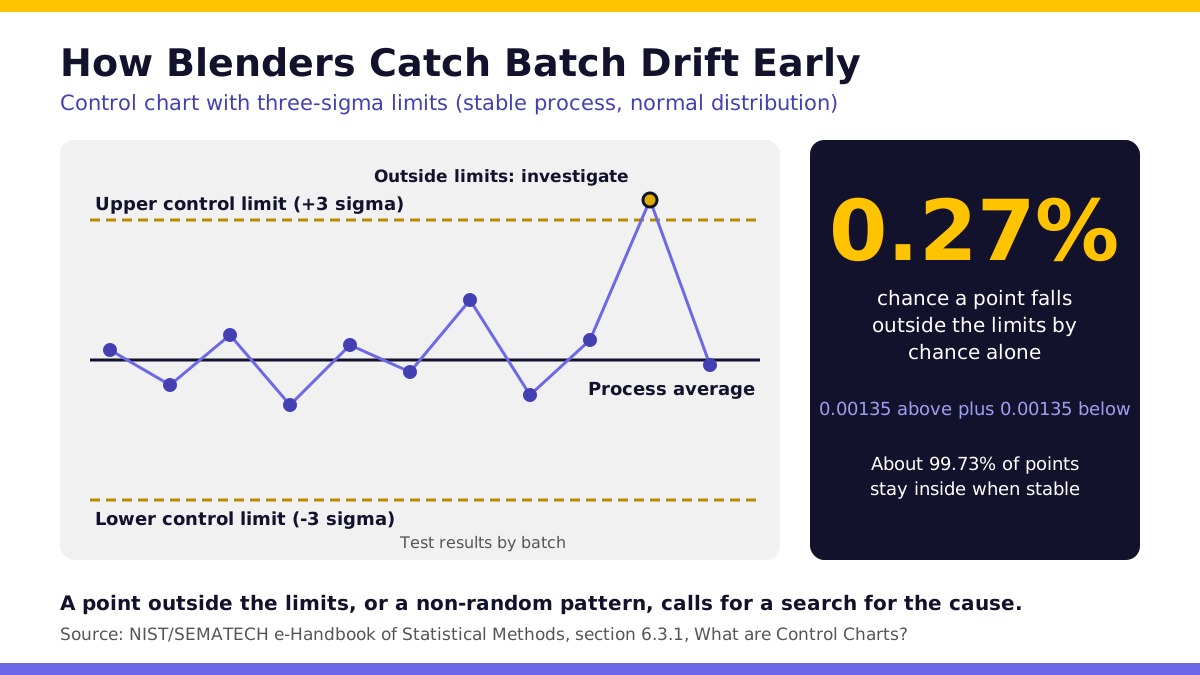
Statistical process control plots test results over time against a center line and upper and lower control limits. The standard approach sets those limits at three standard deviations, which for a normally distributed, stable process leaves only a 0.27% chance that a point falls outside them by chance alone.
A point outside the limits, or a non-random pattern inside them, signals that something in the process has changed and an investigation is warranted. For a blender, that early warning catches raw material drift, equipment wear, or an operator error before it becomes an off-spec shipment.
Documentation proves what was made and how. A contract blender should be able to provide:
Safety data sheets for each product.
Certificates of analysis that report measured results for a batch, where they are part of the agreement.
Batch records and lot tracking for audits, complaints, and recalls.
Compliant labels with the standard hazard communication elements.
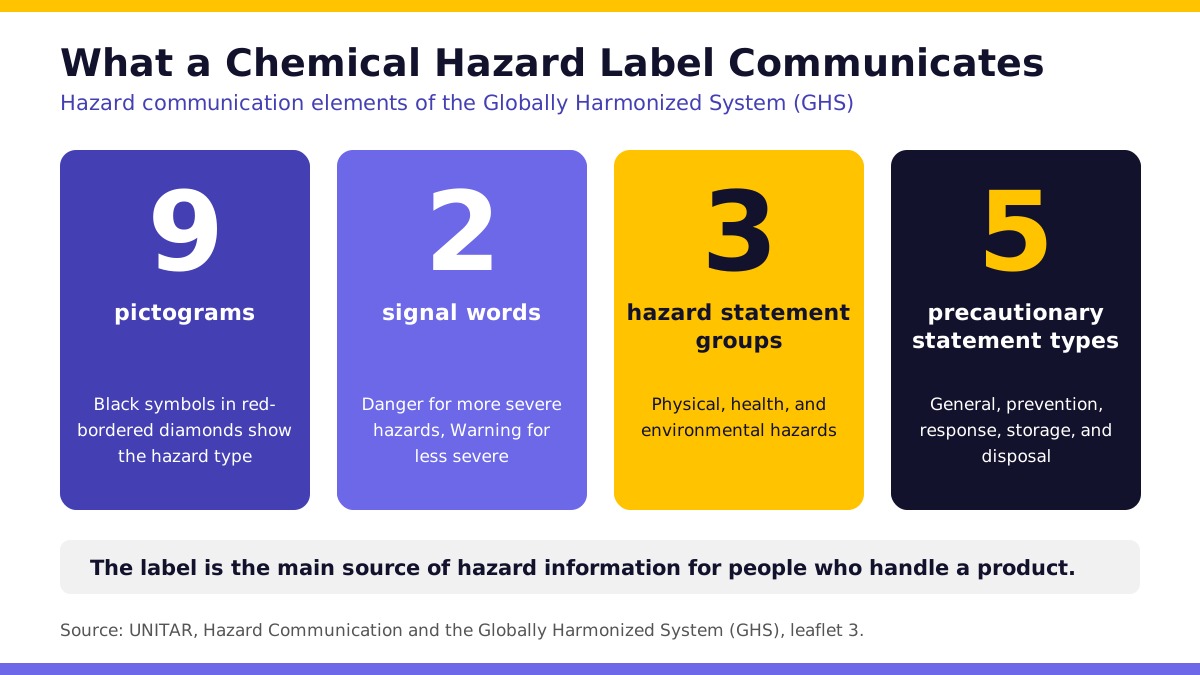
The Globally Harmonized System defines those label elements: nine pictograms, the signal words Danger and Warning, hazard statements, and precautionary statements. Products with hazardous classifications also need containers and labels that meet packaging for hazardous materials.
Contract chemical blending costs depend on batch size, raw materials, formula complexity, testing, packaging, and storage. Every provider prices differently, so the most useful step is to give each one the same complete request.
Cost Driver
Why It Matters
How to Control It
Batch size and run length
Setup and cleanout time is spread across fewer units in small runs
Consolidate orders into fewer, larger runs where shelf life allows
Raw materials
Ingredient price and availability change over time
Share forecasts so materials can be planned in advance
Formula complexity
More ingredients, heating, or mixing steps add time
Simplify ingredient lists and addition steps where performance allows
Testing and documentation
More analysis and reports add labor
Specify the tests that matter for the product
Packaging and labeling
Container type, labels, and hazard requirements affect cost
Standardize container sizes and label formats
Storage and freight
Warehouse time and shipping method add to landed cost
Plan scheduled releases and consolidated shipments
Minimum batch sizes also vary by provider and equipment, so ask for them in writing before you compare quotes.
Benefits of Contract Chemical Blending
The main benefit is access to blending equipment, quality systems, and trained staff without owning them.
Lower capital cost: no blending plant to buy, staff, or maintain.
Faster launches: formulation review, trials, and production run in one workflow.
Flexible volume: scale production up or down with demand.
Consistent quality: controlled processes, testing, and batch records.
Simpler logistics: blending, packaging, and shipping handled together.
Brand focus: your team spends its time on sales and product development.
Contract Chemical Blending by Industry
Contract blending supports many product types, and the industries it serves each carry their own quality concerns.
Industry
Typical Products
Main Blending Concern
Industrial and commercial cleaning
Degreasers, detergents, floor and surface cleaners
Even distribution of surfactants and actives
Automotive
Washes, waxes, additives, and maintenance chemicals
Stability and repeatable performance
Agricultural
Crop inputs and nutrient blends
Accurate concentration of low-dose ingredients
Water treatment
Treatment chemicals in liquid or dry form
Consistent active content in every container
Specialty chemicals
Additive packages and custom formulations
Compatibility and tight specifications
How to Choose a Contract Chemical Blender
Choose a contract chemical blender by checking how it controls quality, not only what it charges. Ask each provider the following:
Ask About
Why It Matters
Experience with your product type
Liquid, powder, emulsion, and surfactant products each have different risks
Equipment and batch size range
Equipment must fit your volumes, from pilot batches to full production
Quality certifications and procedures
Documented systems show how consistency is maintained
Testing and reporting
Confirms what you will receive with each batch
Confidentiality terms
Protects your formula and customer information
Packaging, warehousing, and shipping
Reduces handoffs between vendors
Communication and response time
Fast answers keep launches and reorders on schedule
Private label capability
Lets you sell the product under your own brand
A plant visit, a review of sample batch documentation, and customer references give a clearer picture than any brochure.
Contract Chemical Blending With Industrial Technology Corporation
Industrial Technology Corporation is a family-owned blender with more than 40 years of experience, serving manufacturers that need consistent chemical products. Its services cover liquid, powder, emulsion, surfactant, and degreaser blending, along with packaging, warehousing, and shipping under one roof.
Custom blending: your proprietary formula, mixed to your specification.
Private label:branded product lines blended, filled, and labeled for your customers.
Finishing and delivery: packaging, storage, and shipment arranged with the blend.
Request a Contract Blending Quote
Send your formula or performance goals, volumes, packaging needs, and target dates, and Industrial Technology Corporation will outline how the product can be blended, tested, and delivered. You can request a custom blending quote online or call 1-563-322-4882, Monday through Friday, 8 AM to 4:30 PM.
Contract chemical blending is when a company outsources the mixing, testing, and packaging of a chemical product to a specialist provider. The provider blends the customer’s formula at production scale using its own equipment, staff, and quality systems.
How long does contract chemical blending take?
Timelines depend on formula complexity, trial and pilot needs, raw material availability, and batch size. A formula that needs compatibility trials and a pilot batch takes longer to launch than a repeat order, so ask for a written schedule at the quote stage.
Is contract blending the same as toll blending?
The terms overlap, and many providers use both. Toll blending usually means processing a customer’s formula and materials for a fee, while contract blending often also includes formulation help, raw material sourcing, and packaging.
Can I keep my formula confidential?
Yes. Ask for a confidentiality agreement before sharing the formula, and confirm who at the provider can access it. Reputable blenders treat customer formulas as proprietary information.
What information do I need to start a contract blending project?
You need the formula or performance targets, safety data for each ingredient, expected batch sizes and annual volumes, specification limits, and packaging and delivery requirements. A complete request produces a faster and more accurate quote.
What is the minimum order for contract chemical blending?
Minimum order sizes vary by provider, product type, and equipment. Ask each blender for its minimum batch size in writing, and ask whether smaller pilot runs are available before full production.
Do contract blenders provide a certificate of analysis?
Many do, as part of the agreement. A certificate of analysis reports measured test results for a specific batch, so confirm which tests are included and whether the certificate ships with every lot.
Can a contract blender also package and ship the product?
Yes, many contract blenders also fill, label, store, and ship finished products. Using one provider for blending, packaging, and shipping reduces handoffs and the chance of delays or damage.
In the realm of specialty chemicals, custom chemical formulation is a precision-driven process that demands stringent quality control, regulatory compliance, and timely execution. Underpinning all these elements is a robust system of supply chain management — the backbone that ensures raw materials, production schedules, and customer deliveries are harmoniously aligned. As industries become more global and complex, managing the supply chain in custom chemical formulation is increasingly fraught with challenges.
Understanding Supply Chain Dynamics in Chemical Formulation
Custom chemical formulation involves tailoring chemical blends to meet specific client needs, often in highly regulated industries such as pharmaceuticals, agriculture, food processing, and industrial manufacturing. The formulation process itself is complex and requires the integration of diverse components, including raw material sourcing, batch testing, regulatory documentation, quality assurance, and distribution logistics.
Supply chain dynamics in this context differ markedly from traditional manufacturing:
Diversity of Materials: Custom formulations typically require a wide range of raw materials, many of which may be rare, volatile, or subject to regulatory restrictions.
Variable Demand: Unlike mass production, customer-specific formulations may be ordered in small batches, leading to unpredictable demand patterns.
Compliance Requirements: Regulatory compliance adds another layer of complexity, requiring transparent documentation and secure handling practices throughout the supply chain.
Time Sensitivity: Delays in any stage — from procurement to transportation — can cascade into significant production lags and customer dissatisfaction.
In essence, the chemical formulation supply chain is a delicate balance of science, logistics, and risk management.
Common Challenges and Mitigation Strategies
The nature of the chemical industry makes its supply chain uniquely susceptible to disruptions. Here are some of the most prevalent challenges and recommended strategies to address them:
1. Raw Material Volatility
Many chemical inputs are derived from petrochemicals or agricultural feedstocks, both of which are vulnerable to price and supply fluctuations due to geopolitical tensions, natural disasters, or market dynamics.
Mitigation Strategies:
Diversify the supplier base to avoid over-reliance on a single source.
Establish long-term contracts with key suppliers to lock in pricing and availability.
Implement hedging strategies for critical raw materials to manage cost risks.
2. Regulatory Hurdles
Stringent regulations govern the handling, storage, and transportation of chemical substances, such as OSHA, REACH, TSCA, and others. Non-compliance can result in shipment delays or legal penalties.
Mitigation Strategies:
Maintain a centralized compliance management system that tracks evolving regulatory requirements.
Invest in training for logistics and procurement teams on chemical safety and legal obligations.
Work with regulatory experts or consultants who can offer proactive guidance.
3. Logistics Disruptions
Global transportation networks are frequently disrupted by port congestion, political unrest, or pandemics. These disruptions can stall the timely delivery of raw materials or finished products.
Mitigation Strategies:
Maintain a buffer stock of essential inputs based on risk assessments.
Leverage multi-modal transportation options to reduce dependence on a single shipping route.
Employ supply chain visibility tools to track shipments in real-time and adjust plans as needed.
4. Quality Control
The inconsistency in raw material quality can have a cascading effect on the final product’s performance, leading to rejected batches and costly recalls.
Mitigation Strategies:
Implement robust incoming inspection protocols for all raw materials.
Establish supplier audits and performance scorecards.
Use statistical process control (SPC) methods to monitor production consistency.
5. Demand Variability
Uncertain demand patterns for custom formulations can result in either overstocking or stockouts, each carrying its own financial risks.
Mitigation Strategies:
Collaborate closely with clients to forecast demand more accurately.
Use flexible manufacturing setups that can scale up or down based on order volume.
Implement just-in-time (JIT) inventory systems to minimize waste while ensuring availability.
Tools and Technologies for Efficient Supply Chain Management
To overcome the above challenges, chemical formulators must leverage modern tools and technologies that provide visibility, control, and predictive power.
Enterprise Resource Planning (ERP) Systems
ERP systems integrate procurement, inventory, production, and distribution data in a centralized platform. For chemical manufacturers, an ERP tailored to process industries can effectively manage batch tracking, regulatory documentation, and formula version control.
Advanced Planning and Scheduling (APS)
APS software allows for real-time scheduling and resource allocation based on demand and capacity constraints. This is particularly important for facilities handling multiple custom blends with varying priorities.
Internet of Things (IoT) and Sensors
IoT-enabled equipment can track parameters such as temperature, pressure, and humidity in real-time during chemical processing and storage. This ensures compliance and enhances quality assurance.
Blockchain for Supply Chain Transparency
Blockchain technology offers a tamper-proof way to log transactions, certifications, and chain-of-custody records. This is vital for chemicals that require traceability across global networks.
Artificial Intelligence (AI) and Predictive Analytics
AI-powered platforms can predict demand, flag potential disruptions, and optimize procurement schedules using historical and real-time data. This enhances agility and responsiveness in supply chain decision-making.
Supplier Relationship Management
Strong relationships with suppliers are foundational to a resilient chemical supply chain. These relationships go beyond price negotiations — they encompass collaboration, transparency, and mutual growth.
Best Practices:
Conduct joint planning sessions with suppliers to anticipate material needs and mitigate shortages.
Share performance metrics and improvement goals regularly.
Develop contingency contracts that ensure priority allocation in times of scarcity.
Chemical formulators should view their suppliers as strategic partners, not just transactional vendors.
Inventory and Demand Forecasting
Accurate forecasting is critical to maintaining the delicate balance between availability and cost efficiency. Traditional forecasting models often fall short in the face of customization and demand variability.
Approaches to Improve Forecasting:
Integrate client order histories and industry trends into forecasting algorithms.
Use machine learning models to identify patterns in customer behavior.
Monitor macroeconomic and geopolitical indicators that may affect supply and demand.
Additionally, scenario planning — where multiple demand and supply situations are modeled — can help decision-makers prepare for uncertainties.
Case Studies of Supply Chain Optimization
Case Study 1: Dual-Sourcing Strategy Saves the Day
A mid-sized toll blender faced raw material shortages when its primary supplier in East Asia experienced shutdowns due to geopolitical tensions. By proactively developing a dual-sourcing strategy, the company was able to shift procurement to a secondary supplier in North America without affecting production schedules.
Results:
Maintained uninterrupted production.
Strengthened supplier diversification.
Enhanced reputation with clients for reliability.
Case Study 2: IoT Integration Enhances Storage Safety
An industrial chemical formulation facility integrated IoT sensors across its bulk storage tanks to monitor critical parameters in real-time. Alerts were set up for temperature thresholds and chemical compatibility risks.
Results:
Zero incidents reported in 18 months.
Reduced insurance premiums due to improved risk management.
Streamlined compliance reporting with automated logs.
Case Study 3: AI-Driven Forecasting Boosts Efficiency
A custom blend manufacturer adopted AI-powered demand forecasting tools to replace its manual Excel-based approach. By integrating client sales data and external market indicators, it could predict seasonal spikes with 85% accuracy.
Results:
Reduced inventory holding costs by 22%.
Improved customer service levels.
Cut backorder occurrences by 40%.
Ensuring a Resilient Future for Chemical Formulators
Navigating the complexities of supply chain management in custom chemical formulation demands a multi-faceted approach. It requires foresight, technology integration, regulatory awareness, and strong partnerships across the value chain. As the industry becomes more global and customer expectations rise, supply chain resilience will define competitive advantage.
Industrial Technology Corporation understands the stakes. Whether you’re in need of custom toll blending services, private label opportunities, or quality chemical formulations for your business, we are here to meet your needs. Simply contact us today to inquire about our services, request a quote, or discuss your specific requirements. We look forward to working with you to develop innovative solutions that drive success for your business.
Blending technology continues to play a vital role across industrial sectors, especially in chemicals, pharmaceuticals, food production, and manufacturing. As we move into 2025, blending technology is evolving rapidly, driven by digital transformation, sustainability mandates, and automation. These emerging trends promise to transform how businesses approach formulation, production efficiency, and scalability.
Current State of Blending Technology
Blending technology today has reached a point of high efficiency, precision, and safety in controlled environments. Traditional processes involve the physical mixing of raw materials—powders, liquids, or granules—using various equipment such as ribbon blenders, paddle mixers, high-shear mixers, and static blenders.
Industrial sectors rely on blending for:
Homogeneous mixture creation
Customization of formulations
Batch consistency and quality control
Thermal and chemical process integration
Despite the substantial progress, many current systems are still reliant on operator input, subject to variability, and may lack real-time insights. Additionally, challenges remain in scaling custom formulations, reducing downtime between batches, and optimizing for sustainability.
These limitations are precisely what emerging trends seek to address through transformative technologies.
Key Trends Shaping the Future
Smart Automation and Sensor Integration
Modern blending systems are beginning to incorporate smart sensors and Industrial Internet of Things (IIoT) devices. These tools enable real-time monitoring of parameters like temperature, viscosity, particle size distribution, and blend uniformity.
How it helps:
Reduces reliance on manual sampling
Enables early detection of deviations
Optimizes batch consistency and throughput
With 2025 on the horizon, we expect a broader adoption of closed-loop systems, where automated feedback from sensors adjusts blending parameters on the fly to maintain ideal conditions.
Predictive Maintenance Using AI
Predictive maintenance powered by machine learning is another growing trend. By analyzing historical equipment data, AI can predict component failures before they happen.
Benefits include:
Avoiding costly downtime
Extending equipment lifespan
Reducing repair and maintenance costs
This shift from reactive to proactive maintenance is particularly valuable in high-volume toll blending operations where uptime is critical.
Digital Twins in Process Simulation
A digital twin is a virtual model of a physical system. Blending allows engineers to simulate different formulations, process parameters, and equipment setups without disrupting actual operations.
Use cases:
Testing new chemical formulations
Modeling heat distribution and shear forces
Training operators in virtual environments
By 2025, expect digital twins to be a standard feature in large-scale operations, especially in facilities that require extensive regulatory documentation and validation.
Green Blending Technologies
As sustainability becomes a top priority, the blending industry is adopting eco-friendly practices. These include:
Solventless and low-VOC formulations
Cold blending techniques to reduce energy use
Equipment designed for faster clean-in-place (CIP)
Suppliers are also moving toward biodegradable lubricants, recyclable packaging, and closed-loop waste recovery systems. These changes are driven by both environmental mandates and customer demand.
Modularity and Customization
Manufacturers now require more flexibility from their blending partners. Modular blending systems—designed for fast changeovers and scalability—are gaining popularity.
This trend supports:
Custom toll blending services
Small-batch production with rapid formulation switching
Efficient use of space and energy
In 2025, we anticipate even greater demand for plug-and-play equipment and software that can quickly adapt to changing product lines.
Predictions for 2025 and Beyond
Innovations and Disruptions
Autonomous Blending Systems
The holy grail of blending technology is a fully autonomous system that:
Loads raw materials via robotics
Uses AI to monitor and control the process
Packages the final product automatically
While not widespread yet, pilot programs for lights-out manufacturing are underway in advanced sectors like biotech and electronics. By late 2025, mid-sized manufacturers may begin integrating semi-autonomous modules, especially for repeat formulations.
Blockchain for Supply Chain Transparency
With the growing need for traceability, especially in pharma and food sectors, blockchain will become an important tool. It enables secure, tamper-proof records of:
Source materials
Batch records
Quality testing
For toll blending service providers, this technology adds a competitive edge by demonstrating compliance and trustworthiness to clients.
AI-Driven Formulation Development
AI tools can analyze thousands of formulation parameters to identify optimal blends faster than human chemists. While still in its infancy, this approach can significantly reduce R&D time, particularly for custom chemical blends or high-performance coatings.
Expect hybrid labs—combining human expertise with AI suggestions—to become more prevalent in 2025.
Impact on Industry Standards
Regulatory Compliance
With automation and data analytics embedded in processes, meeting standards like ISO 9001, cGMP, REACH, and EPA regulations will become more streamlined. Real-time data logs ensure traceability and make audits easier.
Worker Safety
Smart systems that reduce manual intervention, such as automated loading and closed systems, enhance safety by minimizing exposure to hazardous materials. Expect updated OSHA protocols and compliance frameworks to reflect these technological advancements.
Quality Control
Advanced sensors will set new benchmarks for precision and consistency. Instead of random batch sampling, continuous monitoring can become the norm. This raises the bar for what constitutes “high quality” in blended products.
Preparing Your Business for Change
Conduct a Technology Audit
Review your current blending infrastructure and identify:
Equipment that’s aging or prone to failure
Manual steps that can be automated
Gaps in data collection and analysis
This audit sets the foundation for prioritizing upgrades.
Partner with Technology-Forward Providers
Whether outsourcing or expanding in-house capabilities, choose partners like Industrial Technology Corporation are already leading the way by offering:
Custom toll blending services
Private label opportunities
Advanced chemical formulation expertise
Invest in Workforce Training
As systems become more complex, your team must be trained to interpret sensor data, manage predictive tools, and work alongside AI-assisted systems. Cross-training across production, IT, and R&D teams can increase operational agility.
Focus on Sustainability Metrics
Regulatory and consumer pressure will only intensify. Prepare now by:
Monitoring your carbon footprint
Reducing water and energy usage
Selecting greener raw materials
This can also be a strong value proposition in your marketing and client communications.
Be Future-Ready with Industrial Technology Corporation
As we approach 2025, the evolution of blending technology presents both challenges and opportunities. From smart automation and predictive analytics to blockchain integration and sustainable formulations, the landscape is transforming rapidly.
To stay competitive, businesses must embrace innovation, upgrade legacy systems, and collaborate with forward-thinking partners.
At Industrial Technology Corporation, we’re committed to being your trusted partner through this transformation. Whether you need custom toll blending services, private label opportunities, or quality chemical formulations for your business, we are here to meet your needs.
Contact us today to inquire about our services, request a quote, or discuss your specific requirements. We look forward to working with you to develop innovative solutions that drive your business’s success.