
Emulsion Blending Services for Stable Industrial Liquid Formulations
Industrial Technology Corporation provides emulsion blending services for manufacturers that need stable, repeatable liquid formulations with controlled dispersion, consistent viscosity, reliable shelf behavior, and packaging-ready production from ITC’s Davenport, Iowa facility.
Controlled shear and phase balance
Industrial liquid formulation support
Packaging and shipping coordination

Emulsion Blending Services for Stable Liquid Formulations
Emulsion blending is used when two liquids that do not naturally stay mixed, such as oil and water, must be combined into a stable and functional product. A successful emulsion depends on far more than agitation. It requires the right formulation chemistry, controlled ingredient sequencing, proper shear, temperature awareness, mixing duration, and repeatable process conditions.
ITC supports manufacturers that need industrial emulsion production for cleaners, degreasers, lubricants, coatings, surfactant-based products, and specialty liquid formulations. The goal is to create a uniform liquid product that resists separation, maintains consistent appearance, flows properly during filling, and performs predictably in the field.
For customers still comparing mixing methods, ITC’s article on low-shear versus high-shear mixing explains why shear level matters when building stable liquid chemical products. For broader liquid production needs, see ITC’s liquid blending services.
- Controlled phase balance for oil-in-water and water-in-oil systems
- Uniform droplet distribution to support product stability and performance
- Viscosity management for pumping, filling, storage, and end-use application
- Documented production steps for repeatable industrial batches
- Packaging-ready output through ITC’s chemical blending and packaging support
Emulsion Blending Services and Production Capabilities
Industrial emulsion products require tight control over how ingredients are combined, dispersed, stabilized, packaged, and prepared for shipment. This overview shows how ITC supports emulsion-based chemical production from formula review through finished product handling.
| Capability Area | What ITC Supports | Why It Matters |
|---|---|---|
| Formula Review | Review of product type, phase ratio, surfactant or emulsifier needs, viscosity targets, and application requirements | Helps confirm the right blending approach before production begins |
| Ingredient Sequencing | Controlled addition of water phase, oil phase, surfactants, emulsifiers, additives, and performance agents | Improves stability and reduces batch-to-batch variation |
| Shear and Mixing Control | Process-driven mixing conditions based on viscosity, raw material behavior, and target dispersion | Supports uniform droplet distribution and consistent finished product texture |
| Stability Considerations | Attention to appearance, separation risk, pH, viscosity, and finished product behavior | Helps protect shelf life and end-use performance |
| Packaging Support | Jugs, pails, drums, totes, bulk options, and private label packaging when applicable | Prepares finished emulsion products for storage, distribution, and customer use |
| Shipping Coordination | Finished goods staging, pallet configuration, carrier scheduling, and delivery planning | Creates a smoother path from production to customer delivery |
Emulsion products that require brand-specific packaging can be coordinated through ITC’s private label chemical packaging service. Products with special handling or regulated shipping requirements may also fit ITC’s hazmat chemical packaging process.
How Emulsion Blending Services Improve Product Performance
A well-made emulsion creates a more functional relationship between ingredients. When the dispersed phase is uniform and stable, the finished product is easier to package, easier to use, and more reliable in real-world applications.
Better Dispersion of Active Ingredients
Many industrial formulations depend on active ingredients being evenly distributed throughout the product. Controlled emulsion blending helps prevent concentration swings, uneven performance, and inconsistent product behavior from one container to the next.
- Uniform performance agents
- Improved wetting and surface contact
- Consistent product behavior after packaging
Improved Stability During Storage
Unstable emulsions can separate, cream, settle, thicken, or lose performance during storage and transport. ITC focuses on the production controls that influence stability, including addition order, mixing time, shear exposure, and packaging compatibility.
- Reduced phase separation risk
- More consistent appearance and texture
- Better shelf and handling behavior
More Reliable Industrial Application
Industrial customers need emulsion products that pump, spray, coat, clean, lubricate, or spread predictably. Repeatable emulsion blending helps manufacturers maintain the product characteristics their customers expect in production and maintenance environments.
- Reliable viscosity and flow behavior
- More even surface coverage
- Consistent field performance
For a closer look at the verification side of blended products, ITC’s article on what QC testing is needed for blended chemical products explains common checks used to confirm consistency, stability, and production readiness.
Industrial Applications for Emulsion-Based Chemical Products
Emulsion-based formulations are used across industrial, commercial, and specialty product categories because they allow manufacturers to combine ingredients with different chemical properties into one usable system.
Cleaners and Degreasers
Emulsions can help cleaning and degreasing products suspend oils, solvents, surfactants, and functional additives in a stable liquid system. This is useful for products that need strong surface contact, residue removal, and predictable dilution behavior.
Related: industrial cleaning chemical blending, degreaser contract blending
Lubricants and Maintenance Fluids
Some industrial maintenance fluids rely on emulsified systems to balance cooling, lubricity, surface protection, and product handling. These formulas need controlled dispersion to keep performance agents distributed evenly throughout the finished product.
Related: specialty chemical blending
Coatings and Specialty Liquids
Coatings, additives, release agents, corrosion inhibitors, and specialty liquids may rely on emulsions for film formation, application consistency, controlled ingredient delivery, or improved compatibility between phases.
Related: surfactant blending services, water treatment chemical blending
Mixing Technologies Used in Emulsion Production
Different emulsion systems require different mixing methods. The right approach depends on viscosity, phase ratio, raw material behavior, desired droplet size, order of addition, and the final use of the product. A process that works for a low-viscosity cleaner may not be appropriate for a thicker lubricant, coating, or specialty industrial liquid.
Emulsion Blending Services for Controlled Dispersion
ITC evaluates the formulation and production requirements before determining how the blend should be processed. Overmixing can damage sensitive ingredients or alter viscosity, while undermixing can leave the product unstable or nonuniform. Effective emulsion production is about applying enough energy to create the required dispersion without compromising the formulation.
- High-shear mixing for smaller droplet size and improved dispersion
- In-tank agitation for controlled batch blending and ingredient incorporation
- Rotor-stator style processing where intense emulsification is required
- Recirculation blending for larger batch uniformity
- Temperature-aware processing for heat-sensitive or viscosity-sensitive formulas
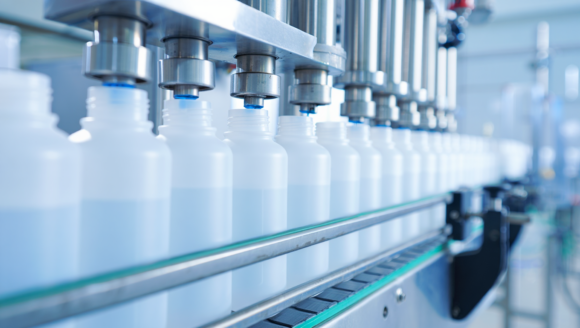
Consistent Particle and Droplet Distribution
Consistent particle or droplet distribution is one of the most important indicators of successful emulsion blending. Nonuniform distribution can create visible separation, inconsistent strength, poor application behavior, and reduced shelf life. A controlled distribution profile supports both product stability and field performance.
Achieving that result requires attention to the entire blending sequence. Raw material order, surfactant interaction, shear exposure, batch timing, temperature, and packaging conditions can all affect how the dispersed phase forms and remains suspended.
Distribution Control Helps Support
- Uniform appearance and texture
- Improved suspension stability
- Predictable viscosity and flow behavior
- Even application across treated surfaces
- Reduced settling, creaming, or phase separation
- More dependable packaging and storage performance
For manufacturers managing multiple liquid product categories, ITC’s toll chemical blending services provide a broader look at how liquid, powder, packaging, and shipping support fit together.
Quality Assurance for Industrial Emulsion Manufacturing
Quality assurance is central to industrial emulsion manufacturing because stable performance depends on more than visual inspection. Emulsion blending services must be backed by documented procedures, in-process checks, and finished product review to confirm that each batch meets the required specifications.
Common Quality Checkpoints
- Raw material identity and batch record verification
- Formula review and production planning
- Mixing parameters and processing condition monitoring
- Viscosity, pH, density, and appearance checks where applicable
- Stability observation and phase separation review
- Packaging compatibility and handling verification
Documentation and Safety Alignment
Emulsion-based products may require SDS coordination, GHS label review, hazmat packaging evaluation, and customer-facing safety documentation depending on the formulation. ITC aligns chemical communication planning with OSHA Hazard Communication standards so labeling and documentation requirements can be considered early in the project.
For regulated formulations, ITC’s hazmat chemical packaging service can support container selection, labeling needs, and outbound documentation. For branded products, private label chemical blending can coordinate formulation, packaging, and brand presentation together.
What to Include When Requesting Emulsion Blending Services
Emulsion projects are easier to quote and plan when ITC has clear information about the formula, product behavior, packaging needs, and performance goals. The details below help determine fit, production approach, and next steps.
Formula and Product Inputs
- Product type and intended industrial application
- Oil-in-water, water-in-oil, or other emulsion type if known
- Formula summary, spec sheet, or target performance requirements
- Viscosity, pH, density, appearance, or stability targets
- Raw material sourcing plan or supplied material notes
- Required batch size and expected production frequency
Packaging and Distribution Inputs
- Container type, fill size, and closure requirements
- Private label or customer label requirements
- Storage conditions and temperature sensitivity
- Hazmat classification, SDS needs, or special handling notes
- Shipping destination and delivery window expectations
- Any required stability, appearance, or release checks
If packaging choices are not finalized, ITC’s chemical blending and packaging page explains available formats and how packaging is coordinated with production. If finished product delivery is part of the project, see warehouse and shipping coordination.
Emulsion Blending Services FAQ
Answers to common questions about emulsion blending, stability, product applications, packaging, and how to request a quote from ITC.
What are emulsion blending services?
Emulsion blending services create stable liquid formulations by dispersing one liquid phase into another liquid phase that would not normally stay mixed. ITC supports industrial emulsion blending for products that require controlled shear, ingredient sequencing, viscosity management, and consistent batch performance.
What types of products use emulsion blending?
Emulsion blending is used for industrial cleaners, degreasers, lubricants, coatings, release agents, surfactant systems, specialty liquids, water treatment products, and other formulations where immiscible ingredients must remain uniformly dispersed.
Why is shear control important in emulsion blending?
Shear affects droplet size, dispersion quality, texture, viscosity, and finished product stability. Too little shear may leave the emulsion unstable or uneven. Too much shear may damage sensitive ingredients or alter the finished product. ITC evaluates the formula and application to determine the proper mixing approach.
Can ITC package emulsion-based products?
Yes. ITC can coordinate packaging for emulsion-based products in formats such as jugs, pails, drums, totes, and bulk options depending on product requirements. Packaging support can also include private label packaging, hazmat packaging evaluation, pallet configuration, and finished goods staging.
How does ITC help maintain emulsion stability?
ITC helps maintain emulsion stability through formula review, controlled ingredient sequencing, shear and mixing control, in-process checkpoints, batch documentation, and finished product review. Stability depends on the full process, not one single mixing step.
Does ITC support private label emulsion products?
Yes. ITC can support private label emulsion products through blending, packaging coordination, label planning, and shipping support. This is useful for brands that sell industrial cleaners, lubricants, specialty liquids, or other emulsion-based products under their own name.
How do I request a quote for emulsion blending services?
Use the ITC quote request form or call (563) 322-4882. Include your product type, formula or spec sheet, emulsion type if known, target batch size, packaging format, stability requirements, timeline, and shipping destination.
Request Emulsion Blending Services from ITC
ITC helps manufacturers produce stable emulsion-based chemical products with controlled mixing, repeatable batch procedures, packaging support, and nationwide shipping coordination. Send the team your formulation details, target batch size, packaging needs, and timeline to begin the feasibility review. For related liquid production support, review ITC’s surfactant blending services and liquid blending services.